 12 hours ago
25
12 hours ago
25
In August 2017, the Miami Dolphins — whose owner Stephen Ross previously launched a nonprofit to fight systemic racism — signed quarterback Jay Cutler after an injury to starter Ryan Tannehill, even though Cutler had already retired. NFL team executives, meanwhile, used the media to try to throw water on the idea that Kaepernick was blackballed.
Some coaches and GMs did reach out, Kaepernick says, and explicitly told him, “Yeah, we want to bring you in, but it’s getting shut down above us.”
One of those coaches, writes Kaepernick in his book, was John Harbaugh, the then-head coach of the Baltimore Ravens. Kaepernick spoke extensively with Harbaugh during the summer of 2017. Harbaugh’s brother Jim was Kaepernick’s coach during the 49ers’ run to the Super Bowl.
Kaepernick writes that Harbaugh was “pushing” to sign him, but was “shut down from above.”
In October 2017, Kaepernick filed a grievance against the NFL under the terms of the league’s and players’ collective bargaining agreement, alleging that owners were colluding against signing him due to his protest.
“Everybody believes that he was blackballed,” says one former player who was in the league during 2016. “Players knew that this would happen. That was a firm belief around the league.”
Goodell pushed back on the notion of organized collusion to keep Kaepernick out of the NFL.
“Those are decisions that each individual owner has to make and their clubs, coaches, GMs,” Goodell told NBC in 2020. “And I’ve talked to a lot of our clubs about it and I’ve encouraged them. I’d love to see him play again.”
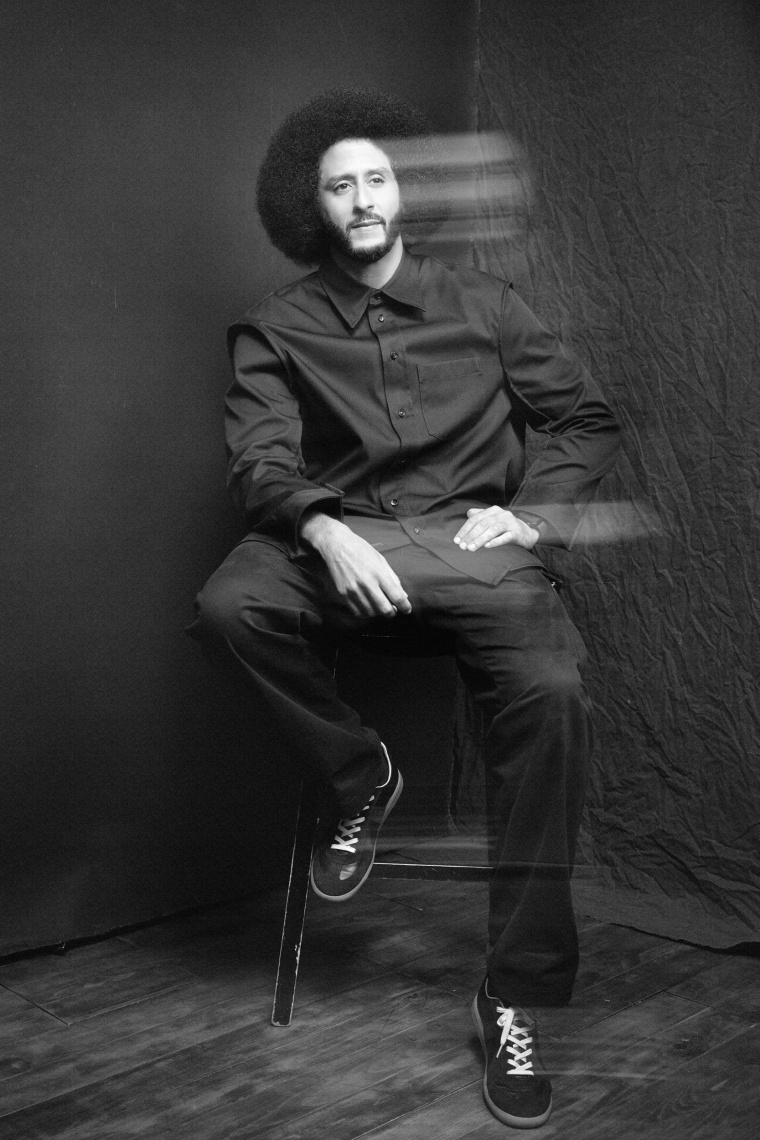 Jesse Dittmar for NBC News
In November 2019 — months after the NFL settled Kaepernick’s lawsuit — the league tried to arrange a midseason workout for him in front of all 32 teams. The details of this day are now infamous, as Kaepernick ultimately called off the NFL’s workout the morning of due to an extensive waiver he refused to sign — a waiver Kaepernick believed would sign away his employment rights and potential future claims — and instead managed to organize a workout of his own.
The dissolution of the workout drew another round of skepticism, with many claiming Kaepernick was pulling a media stunt or was not serious about wanting to play again.
While Kaepernick was out of the league, the NFL went about trying to turn the temperature down on his protest, battling the aftermath of an especially divisive election and a ratings slide some attributed to the player demonstrations.
The league partnered in 2017 with the Players Coalition, a group founded to address systemic racism, and has since committed over half a billion dollars to various social justice causes. Kaepernick wasn’t part of the group. (Reid said in 2017 that Kaepernick was kicked out of communications with the group by co-founder Malcolm Jenkins, which Jenkins denied.)
The NFL did whatever it could to stop the kneeling, the former player says, believing the league wanted to weed out players who kneeled: “What happened was the league and the Players Coalition came to a deal, and then the league did what they were going to do … They wanted their games to go back to normal.”
Kaepernick’s protest likely cost him tens of millions of dollars, even accounting for whatever he got from the NFL in the settlement.
But as his career was sacked, as television pundits continued to make personal attacks, and as 986 people were killed by police in 2017, Kaepernick stayed largely quiet.
He says that was by design.
“No individual should be speaking for everyone across the country. I don’t think that’s a responsible way to approach things,” Kaepernick says. “It’s also being able to enable other people to step into leadership positions, because that’s what movements actually are. It’s not one person just driving things.”
Months after his workout snafu, events unrelated to Kaepernick raised the volume on his protest once more.
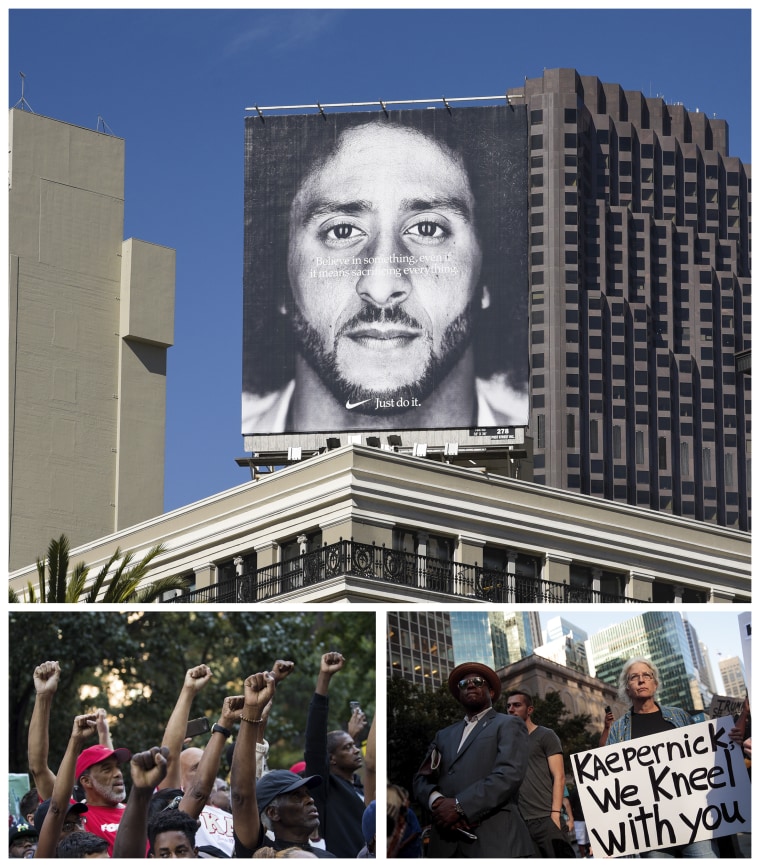 Nike included Kaepernick in its 30th anniversary "Just Do It" campaign in 2018. Supporters gathered outside NFL headquarters in New York City after Kaepernick filed a grievance against the league alleging that owners were colluding against signing him because of his protest.
Getty Images file
Nike included Kaepernick in its 30th anniversary "Just Do It" campaign in 2018. Supporters gathered outside NFL headquarters in New York City after Kaepernick filed a grievance against the league alleging that owners were colluding against signing him because of his protest.
Getty Images fileOn May 25, 2020, 46-year-old George Floyd was killed by police officer Derek Chauvin in Minnesota.
Video revealed Chauvin kneeled on Floyd’s neck for over nine minutes, killing him. Chauvin was convicted on multiple murder charges in 2021.
Nearly four years after Kaepernick kneeled in response to police brutality, worldwide protests emerged in the wake of Floyd’s killing. Kaepernick says seeing the protests around the world made him hopeful in the moment, especially as people in some cases risked their own well-being to be heard in the middle of the pandemic.
“There was a significant portion of the population that previously was disconnected from these realities,” Kaepernick says. “It was like, oh, actually I have to sit with this now and I have to grapple with this. And am I OK with this? And what is my role within this? Am I complicit?”
Corporations also scrambled to meet the moment, including the NFL. In June 2020, several NFL players coordinated social media posts asking for the league to condemn racism and “admit wrong in silencing our players from peacefully protesting.”
The next day, Goodell responded in a video message.
“We, the National Football League, condemn racism and the systematic oppression of Black people,” Goodell said in the video, echoing the words players demanded from him. “We, the National Football League, admit we were wrong for not listening to NFL players earlier and encourage all to speak out and peacefully protest. We, the National Football League, believe Black lives matter.”
Kaepernick wasn’t impressed.
“His response through that video was only because of pressure from players, not because it was altruistic,” Kaepernick says.
The idea that the league should have listened to protesting players “is so laughable in my mind, and so disingenuous,” Kaepernick says. “We had been trying to address the issue that the NFL created with blackballing me for years. To come out and say we should have listened on the back of that — while I’m still actively trying to play in the NFL — it’s so performative.”
Starting the season after Goodell’s video, the NFL began adding messages such as “Choose Love” and “End Racism” in the end zones of every stadium. It continued donating millions to the Inspire Change fund. In 2021, the league expanded on its Rooney Rule, which requires teams to interview at least two minority candidates for certain jobs.
“‘End Racism’ in the back of the end zone is a great marketing campaign, but what are the actions behind it?” Kaepernick says. He adds that at the same time the league was putting slogans on the field, it was employing the practice of “race norming,” arguing that Black players began their careers with lower cognitive function in an effort to deny them payments as a result of a 2013 concussion lawsuit. (The NFL halted the practice in 2021.)
“I don’t think the NFL has materially changed. None of their actions show that,” Kaepernick says. “We have seen it time and time again. For them it has gone back to business as usual, and I think that is a tragedy that we have allowed them to be able to get to that point.”
In a statement to NBC News, the NFL said: “The issues Colin and other NFL players raised remain important to the league and deserving of continued attention and action,” noting the league still works with Inspire Change to “support meaningful progress.”
The NFL added: “Since 2017, that work has reached thousands of national and grassroots partners, backed by more than $575 million in contributions. We remain committed to listening, collaborating, and taking action that creates lasting impact.”