 4 hours ago
18
4 hours ago
18
In the summer of 2025, the government of Brazil suddenly found itself in a deep crisis. The Trump administration had unexpectedly imposed 50 percent tariffs on the country’s products, threatening everyone from coffee planters to shoe manufacturers. At the same time, the United States canceled the visas of eight Brazilian supreme-court justices and placed unprecedented financial and travel sanctions on a powerful justice and his family.
Explore the October 2026 Issue
Check out more from this issue and find your next story to read.
Many things about this crisis were novel. For the first time anyone could remember, an American administration had used tariffs not for economic reasons but as a tool to influence the internal politics of a friendly democracy. President Trump was publicly fulminating against what he called the “WITCH HUNT” against Jair Bolsonaro, the former president of Brazil, who was then on trial for plotting to carry out a coup after losing an election in 2022. Some of Bolsonaro’s followers had stormed Brazil’s Parliament and other federal buildings, likely inspired by the actions of Trump supporters on January 6, 2021. Steve Bannon, who called the Brazilian insurrectionists “freedom fighters,” was one of many MAGA boosters who cheered them on. When combined with local grievances, the language of American election denial was right at home in Brazil.
The U.S. has used financial sanctions and visa bans in the past—but only to punish dictators, criminals, and people accused of grand-scale international corruption or brutal atrocities. Brazilian Justice Alexandre de Moraes had never been credibly accused of any of this. But by the Trump administration’s reckoning, he had two strikes against him: First, de Moraes’s court was trying Bolsonaro; second, he had provoked the ire of Elon Musk, Trump’s largest election donor. De Moraes “needs to leave,” Musk said, comparing him to Voldemort, after de Moraes threatened to fine X and ordered it to block accounts accused of spreading disinformation.
The crisis was novel in other ways too. In normal times, the Brazilian government is reasonably well connected in Washington, regardless of who runs either country. The tenth-largest economy in the world, Brazil cooperates extensively with U.S. law enforcement and regional organizations. Yet at this crucial moment, with billions of dollars in the balance and Brazil’s sovereign democracy under attack, Brazilian officials suddenly found that nobody in the Trump administration would speak to the formal representatives of their left-leaning president, Luiz Inácio Lula da Silva. Brazil’s ambassador to Washington found herself isolated. The foreign minister, a diplomat who had known U.S. Secretary of State Marco Rubio for decades, could not get through to anyone. A junior official told me that even his graduate-school classmate at the U.S. Treasury would not answer his calls.
The Brazilian finance minister at the time, Fernando Haddad, finally managed to schedule a call with U.S. Treasury Secretary Scott Bessent. But two days before the meeting was to take place, the Treasury Department canceled it—and then Bessent used the same time slot to meet with Eduardo Bolsonaro, the former president’s son. The younger Bolsonaro—who lives in Texas, has befriended Donald Trump Jr., and attends Conservative Political Action Conference (CPAC) meetings—was flaunting his connections in Washington, which were manifestly better than those of Lula’s administration.
Autocracy in America: The kleptocracy club
That put the Brazilians in a strange position. “All the official channels that we have, they just suddenly went out of touch,” the junior official told me. “And what happened is that myriad informal actors just started knocking at our doors. And that was interesting.”
Some of these visitors were types not previously known in Washington: lobbyists advertising their relationships not with government officials but with the people who hang around Mar-a-Lago, or with MAGA influencers whose X accounts can attract the president’s attention. Others were business operators offering government favors while seeking to make deals for themselves: An investor who claimed to own a vacation home near Bessent’s offered to arrange a meeting with the Treasury secretary in exchange for access to crucial minerals for himself. The Brazilians declined that offer.
A truce was finally arranged, multiple people told me, with the help of Joesley Batista, a billionaire whose meatpacking company does business in both the U.S. and Brazil, and whose American subsidiary had donated $5 million to Trump’s inauguration (more than the contributions of Amazon, Meta, and Google combined). Batista had no official government role, but his money may have given him the clout to influence Trump’s meetings with Lula at the 2025 United Nations General Assembly, in New York City, and at a summit in Kuala Lumpur, where the two elderly populists, each with grievances against their respective establishments, hit it off. The tariffs were reduced.
The détente was temporary. When I visited São Paulo and Brasília this past spring, the State Department had just appointed a new senior adviser on Brazil policy. Before working for the administration, Darren Beattie founded Revolver News, a website that promoted the “Fedsurrection” conspiracy—the belief that federal agents were behind the riots on January 6, an obsession that would naturally appeal to Brazil’s election deniers and displease the elected president. When Beattie asked to visit Brazil for a minerals conference, the Brazilian government refused to grant him a visa, in part because it suspected that his true purpose was to visit Jair Bolsonaro, then in prison.
Among the journalists, analysts, and officials I met in Brazil, the main topic of conversation was not whether the U.S. would intervene in the country’s elections this fall but how. Flávio Bolsonaro, another of the ex-president’s sons, is running for president, and the Trump administration seems to be looking for ways to help. In June, when a Brazilian court handed Flávio’s brother Eduardo a prison sentence for seeking to get the U.S. to intervene in his father’s trial, Trump’s State Department denounced the conviction as “lawfare.” In July, the administration planned to send two envoys to Brazil to meet with election deniers and “investigate” the Brazilian electoral system; their visa requests were also turned down. A Brazilian public-policy professor told me he wouldn’t be surprised if American social-media platforms quietly began to help Bolsonaro. These tech companies have already shown that they will “flip ideology” to align with changes in the American government. So why not in Brazil?
Slowly, the Brazilians were learning the same lesson as other American allies around the world: The United States of America is no longer the entity they knew. And American power is no longer deployed solely by trained diplomats and reliable officials, working through state channels. Informal envoys, private companies, online grifters, and hardened ideologues both inside and outside the government matter more. Unlike their predecessors, these people do not talk about spreading democracy, and don’t want to build long-term relationships. They don’t care about America’s reputation. They are deploying the tools of American diplomacy and government for their own purposes, to promote their own business interests or their own ideological goals, because, suddenly, they can.
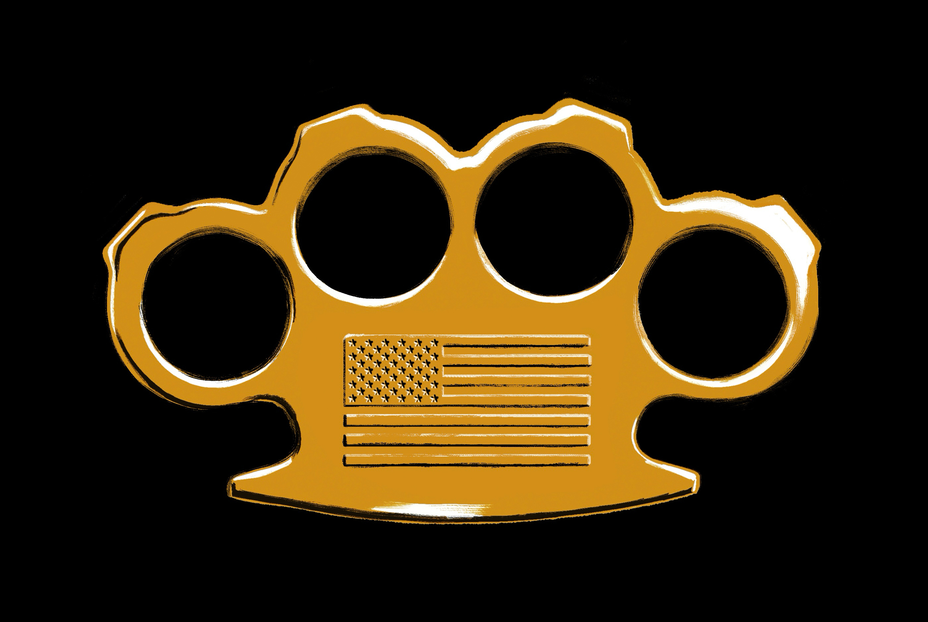 Illustration by Ben Hickey
“Revolutions are the locomotives of history,” Karl Marx wrote. He was wrong about many things but not about this: In modern times, every major revolutionary movement has sought to change not just the politics of a single country but the international system itself. Napoleon marched the French Revolution across Europe. Lenin and Trotsky believed that their Bolshevik Revolution would succeed only when the Soviet Union was surrounded by other Communist states. Ayatollah Khomeini and his successors built proxy movements to spread their ideology across the Middle East.
Anne Applebaum: Kleptocracy, Inc.
The clan of predators currently in charge of the U.S. federal government is no different. Wrongly described as “isolationists,” many of its true believers don’t think of themselves as ordinary Republicans who won an election and will temporarily hold power until the next election. Nor are they mere appendages of Trump. They believe they represent something much greater: the vanguard of a movement that will alter not just America, but the world.
Like earlier revolutionaries, they do not believe that their opponents are legitimate rivals or, as John McCain once described Barack Obama, decent citizens with whom they happen to disagree. Their enemies are existential, and they are international: super-spreaders of a “wokeness” plague, or proponents of a fictitious “censorship-industrial complex,” or advocates of “regulation” that will hamper American business, or self-hating promoters of “mass migration” who want to drown Western civilization in a sea of brown-faced aliens. To maintain their power and defeat these enemies, the predators, like their Bolshevik counterparts, cannot rely on traditional diplomacy, because they don’t trust its practitioners.
Nor do they trust many of the leaders of the democratic states that have long shared the same political and economic values as America. Although the U.S. military and intelligence services continue to cooperate closely with allied governments, the ideologues in and out of the administration are actively seeking to replace them with people and parties who share their disdain for liberal democracy and for what were once considered, at least aspirationally, to be American values. To do so, they need to expand their global influence, manipulate elections in former partner nations, and alter the flows of money and power, especially inside other democracies. Much of the world has always believed America’s defense of democracy to be hypocritical, and that American-led economic integration was self-serving. But now even the people who sincerely believed in the postwar American project are discovering that it no longer exists.
Like all revolutions, this one has many faces. The Bolsheviks had an ideology, a plan to destroy the old social order and establish a dictatorship of the proletariat. But a motley array of other people—advocates of free love, avant-garde painters, grifters fleecing ex-aristocrats—took advantage of the chaos to promote their own agendas. Different kinds of revolutionaries are now pushing the “Make America Great Again” movement in different directions too.
From the March 2019 issue: Russian-style kleptocracy is infiltrating America
Some are ideologues such as Bannon and Beattie, people who believe that Western civilization is being destroyed by racial diversity, secularism, and the commitment to human rights. “Competent white men must be in charge if you want things to work,” Beattie once wrote on X. “Unfortunately, our entire national ideology is predicated on coddling the feelings of women and minorities, and demoralizing competent white men.” Bannon first compared himself to Lenin and talked about smashing the “administrative state” more than a decade ago.
These ideas, once marginal, are now central to American foreign policy. At last year’s Munich Security Conference, Vice President Vance assailed “the retreat of Europe from some of its most fundamental values.” At this year’s Munich Security Conference, Rubio said the same thing more politely. In the face of “an unprecedented wave of mass migration that threatens the cohesion of our societies,” Rubio, the son of immigrants, called on America and Europe to work together in the name of our “shared history, Christian faith, culture, heritage, language, ancestry.” He said nothing about a shared commitment to democracy, transparency, or the rule of law.
The corollary to this thesis, expressed last year in the Trump administration’s National Security Strategy, is that America has a special interest in the politics of the historically white, Christian nations of Europe, and in promoting the far-right political leaders and movements working to keep Europe white and Christian, even though most of them are not currently in power. That document made it clear that although America will no longer intervene to promote democracy at all, anywhere in the world, it is now American policy to “help Europe correct its current trajectory”—language that justifies direct U.S. intervention in European politics to prevent what the document enigmatically calls “civilizational erasure” and to help the allies of the ideologues take power. In “The Need for Civilizational Allies in Europe,” an essay published on the State Department’s Substack, a 27-year-old Trump appointee named Samuel Samson accused Europeans of waging “an aggressive campaign against Western civilization.”
The fight against this existential threat is under way. Sarah Rogers, the undersecretary of state for public diplomacy, told Congress this year that America is now “fully utilizing all the tools at our disposal—exchange programs, cultural heritage initiatives, micro-grants, and more—to advance the President’s America First agenda.” In practice, this means that the American government is using diplomatic pressure, visa bans, and cultural funding to support political parties and leaders deemed to be “civilizational allies” in its international struggle and to undermine its opponents, even when those opponents are the leaders of legitimate governments that have long-standing relationships with the U.S. Samson has held friendly private meetings with far-right European leaders and party representatives, including the Alternative for Germany (AfD); Rogers had a much less friendly meeting with representatives of an actual European government. On a recent visit to the United Kingdom, Rogers denounced what she described as a migrant-led crime wave and accused those present of failing to contend with their country’s problems. In reality, British crime levels have been falling, but genuine facts about Europe—a continent where people live longer, have better health care, and are far less likely to die in mass shootings than Americans—are rarely allowed to undermine the narrative.
In its own hemisphere, the State Department is committed to a more openly imperialist project. The National Security Strategy implies that other governments in North and South America should capitulate to the demands of American officials or companies, and that if they don’t, the U.S. will work to change those governments. As in Europe, the Trump administration will push hard to elect, and to keep in power, politicians who support American dominance: We “will reward and encourage the region’s governments, political parties, and movements broadly aligned with our principles and strategy,” the National Security Strategy declares. When Trump ordered U.S. Special Forces to seize President Nicolás Maduro and his wife from Venezuela and his administration exploited the country’s oil, that was understood by legitimate democratic leaders in our hemisphere (which Maduro was not) as a warning: This can happen to you.
For some regional politicians, this looks like an opportunity. In October 2025, Flávio Bolsonaro, the presidential candidate, suggested that the U.S. could expand its military attacks on small, allegedly drug-carrying fishing boats. Wouldn’t the American military like to “spend a few months” in Guanabara Bay, off the coast of Rio de Janeiro, he asked, “helping us fight these terrorist organizations?” When the U.S. State Department duly designated two Brazilian crime syndicates as “terrorists” this past spring, against the wishes of the Brazilian government, some wondered whether the U.S. was preparing the justification for a future intervention.
others have different, more immediate reasons for wanting to “Make America Great Again.” These include executives from the oil-and-gas, cryptocurrency, and rare-earth-mining industries, and above all big tech companies. Their motivations differ from those of the ideologues, but they share the belief that only power matters, and that only superior humans—richer, more intelligent, usually male and white—should have it. “We live in a world in which you can talk all you want about international niceties and everything else,” White House Deputy Chief of Staff Stephen Miller told CNN’s Jake Tapper in January, “but we live in a world, in the real world, Jake, that is governed by strength, that is governed by force, that is governed by power. These are the iron laws of the world that have existed since the beginning of time.” Miller’s words surely appealed to the business leaders who are delighted to see the tools of American government and diplomacy being redeployed, not to build a world that’s safe for democracy, or even safe for Americans, but to create a world that’s profitable for them.
Many of the unconventional figures who now act in the name of the U.S. are already working to make this dream real. In January, Steve Witkoff, the real-estate dealer turned U.S. special envoy, told a roomful of European presidents and prime ministers gathered in Paris to discuss support for Ukraine that he was already negotiating energy and mineral deals for American companies with Russia, to be implemented after the war. This surprised many of the meeting’s attendees, whose main concern was bringing peace to Ukraine. (A White House spokesperson denied that Witkoff made this statement.) Witkoff also specifically mentioned the role that the U.S. investment company BlackRock could play in the reconstruction of Ukraine, an unusual comment for a peace negotiator. But maybe not a surprising one: BlackRock CEO Larry Fink has sat next to Jared Kushner while he negotiated with the Ukrainians, according to The New York Times.
Trump’s Board of Peace, the quasi-governmental organization whose rules read like those of an exclusive golf club—Trump, as chair, has the right to name his successor, select the board, and determine the mission—presents the same dilemma: Is this organization, much of whose funding is not transparent and comes from member states in the Persian Gulf, designed to make peace, or make money? Does it represent the views of America, or of its funders? In the name of rebuilding Gaza, the board, according to The Guardian, has sought to grant itself the power to seize Palestinian land and buildings, perhaps paving the way for American companies to enact the “New Gaza” plan, a redevelopment project proposed by Kushner, a private citizen (and Trump’s son-in-law) who is of course a board member, as well as Witkoff’s negotiating partner on Russia.
Other projects are more narrowly designed to benefit family members and friends of the president. Last year Trump, along with Commerce Secretary Howard Lutnick, helped negotiate access to one of the world’s largest untapped tungsten reserves, in Kazakhstan, for a low-profile American mining company. The New York Times reported that the deal, which is supported by $1.6 billion in federal financing, benefits Trump’s sons, who are partial owners of an investment bank with a stake in the project. Lutnick’s sons oversee another company, Cantor Fitzgerald, involved with the deal. (Trump’s sons have said that they had no role in shaping the details of the deal. A spokesperson for Cantor Fitzgerald told the Times that the company’s executives were not involved in discussions of government funding.) But this is only one example: Trump’s children are also negotiating private business deals in the Middle East, Europe, and Asia, where local leaders have a clear interest in impressing their father. According to The Washington Post, Trump’s sons have also invested in numerous defense-tech companies that have received Pentagon contracts or other federal funding. “There are no conflicts of interest,” a White House spokesperson told the Post when asked about the report.
According to the Times, Trump himself earned an unprecedented $2.2 billion in the first year of his second term, much of it from cryptocurrency projects. But he also enjoys exercising power over other people, and uses the tools of government to do that. His tariffs give him financial and personal leverage over foreign leaders. His invasion of Venezuela gave him an apparent victory over an old enemy, but also opaque control of Venezuela’s oil, which he has bragged about repeatedly. His use of unconventional envoys helps him manage these various interests, many of which would have in the past been considered immoral or possibly illegal. Fiona Hill, a civil servant on the National Security Council during Trump’s first term, told me that even then, the president was surrounded by people who were “quasi-thinking that they were representing American interests, but they were also representing their own.” He still is.
 Illustration by Ben Hickey
Sometimes, the goals of the civilizational warriors, the oligarchs, and Trump directly align. Consider their joint war against the European Union’s Digital Services Act, which regulates how social-media companies, search engines, and other online organizations protect users’ rights, handle illegal content, and generally look after the public interest. The State Department ideologues describe this law as “censorship” that is damaging not only to Europeans but to Americans. At an event in Washington this past spring, Sarah Rogers spoke of a “censorship class” that had allegedly been active under the Biden administration before it “scuttled to Europe” after the 2024 election.
Although several lawsuits have sought to prove otherwise, there is no evidence that the Biden administration silenced anybody. Nevertheless, the State Department takes this “threat” so seriously that it has imposed visa restrictions on Thierry Breton, a former EU commissioner who is now a private citizen, for his role in creating the Digital Services Act, as well as four other Europeans who campaigned for the law, paradoxically curbing their freedom of speech. A German official told me that Americans regularly bring up their objections to the act during bilateral negotiations, even though the law—passed by the European Union, not Germany—has been in effect since 2022.
The reality is that the Digital Services Act says nothing about censorship, especially not of Americans. The law requires digital platforms to protect minors, comply with European laws—laws that are made by democratically elected legislatures and that, in Germany and elsewhere, forbid Nazi propaganda and Holocaust denial, as well as child pornography and incitement of terrorism—and provide transparency about their use of algorithms. Europeans don’t have the same speech laws as Americans, but they have the right to enact and enforce their own laws, just as they have a right to different food-safety or air-pollution laws. American companies operate all over the world in accordance with the local laws. But in Europe, U.S. tech companies and the U.S. administration are jointly seeking to change not just the laws, but the political and legal order that wrote them. Different faces of the revolution coincide conveniently here: The promotion of anti-European, far-right political parties serves both the profit-making interests of the tech companies and the ideological interests of the “free speech” defenders. Elon Musk, for example, openly uses his social-media platform, his political donations, and the clout that his companies give him inside the U.S. government to oppose many forms of digital regulation, to push racist conspiracy theories, and to promote the civilizational allies of the predator clan. He has made video appearances at a far-right “Unite the Kingdom” rally—“Violence is coming to you,” he told those gathered in London; “you either fight back or you die”—and at a rally of the AfD, which Germany’s domestic intelligence agency classified as a right-wing extremist group. His platform has also been used to promote fear and misinformation, even to fuel violence that could destabilize sitting governments. After a stabbing in Southport, England, in 2024, viral posts falsely claiming that the suspect was a Muslim and an undocumented migrant spread rapidly to millions via X and other platforms, inflaming the riots that ensued.
The promotion of foreign political parties for commercial gain is not new. In 2018, Steve Bannon sent a message to Jeffrey Epstein, preserved in the Justice Department’s cache of Epstein files, suggesting that the success of extremist European political parties would make life easier for the cryptocurrency industry. In the message, Bannon described himself as an adviser to Italian, German, and Swiss far-right political parties, among others, as well as to Hungary’s Viktor Orbán and Britain’s Nigel Farage. Anticipating a victory in the upcoming European parliamentary elections, he told Epstein that “we can go from 92! seats to 200” and then “shut down any crypto legislation or anything else we want.” “Roger that,” Epstein responded.
Bannon, who by then had left the Trump administration, was not publicly claiming to speak for America or its interests. But people with views similar to Bannon’s are now speaking for America, and their impact on the international system is as dramatic as the Bolsheviks’ once was. I don’t mean that they will destroy the United Nations or the system of international law that Elbridge Colby, the Pentagon’s undersecretary of policy, disdainfully calls the “cloud-castle abstraction of the rules-based international order”; those things are already so weak that they have ceased to matter.
Rather, the change is inside the democratic world that came into being after 1945, a world based not exclusively on law, but on a set of mostly self-imposed restraints. Inside this sphere, American power was largely derived from alliances that it refrained from exploiting. Long-term relationships were held to be valuable, because you never knew when you might need your allies. U.S. politicians did not execute American foreign policy, or indeed domestic policy, in order to make money for themselves or their children while they were still in office. These alliances achieved enormous success: Although American policy in the Middle East has always been controversial and the results of American military interventions around the world mixed at best, America helped build eight decades of peace, prosperity, and eventually democracy in Europe and much of Asia, creating markets for U.S. companies and unprecedented support for U.S. power.
This world is fast disappearing. Instead, following the president’s lead, different people inside and outside the administration are seizing the revolutionary moment in order to win zero-sum victories. Countries that hang back from this free-for-all know they will suffer. “If we’re not at the table, we’re on the menu,” Canadian Prime Minister Mark Carney said at Davos earlier this year. He was right.
In May, the governor of Louisiana landed in Nuuk, the capital of Greenland, declaring that he had come to “make a bunch of friends.” Jeff Landry is Trump’s “special envoy” to Greenland, a title that comes with no salary and no recognition from Denmark, of which Greenland is a semiautonomous territory. Landry had nevertheless told Trump, on X, that “it’s an honor to serve you in this volunteer position to make Greenland a part of the U.S.”
Upon his arrival, Landry changed into camouflage pants, as if he were preparing for combat. He attended a business conference to which he had not been invited. He tried to hand out MAGA hats, without much success. Although Louisiana is near the bottom of all U.S. health-care rankings, and although Greenland has full access to a state-funded national health service, Landry brought a doctor who seemed to be there to discuss Greenlandic health care. On the day after Landry’s departure, Greenlanders staged a large protest outside the new U.S. consulate, which they had dubbed “Trump Tower.” After returning home, Landry nevertheless told Fox News that the people he had met “want more U.S. involvement in Greenland.”
The visit was farcical, but no one in Denmark was laughing. Ever since the surreal, shocking days in January 2026 when the Danish army brought blood banks to the island and prepared to blow up airport runways to thwart a possible U.S. invasion, the government in Copenhagen has been watching the Americans who visit Nuuk, some for business, some for politics, some for a strange mix of both. In August, for example, an American oil company called Greenland Energy began bringing equipment to drill for oil in a remote part of the island, although it had not received formal permission to do so. Greenland Energy’s investors include Ken Griffin, a major donor to the Republican Party. Dr. Phil, the former talk-show host and prominent Trump supporter, has been commissioned to make a documentary series about the project, designed to “capture the mission of these modern-day wildcatters.” The company offered locals huge salaries—$185,000 annually, well above the national average—and talked up the potential size of the oil deposit. (Greenland Energy has said that it hasn’t officially started recruiting employees, and that high salaries are standard for specialized security guards.) A local leader told me that this talk of big money seemed ominous to Greenlanders, and in several towns, people staged protests against the drilling project. In mid-August, officials in Greenland formally postponed the drilling.
Larry Swets, the company’s executive chair, told Fortune that the project is not related to American annexation. But two days after the Greenlandic government warned that it had not given the company permission to deliver equipment, Trump posted an AI-generated photograph of himself glowering over a Greenlandic village beneath the headline “Hello, Greenland!” So is Greenland Energy there for politics, for business, or both?
Equally hard to assess are the motives of Dryden Brown, a co-founder of Praxis, which Brown has described as a “crypto-native country” that has financial backing from, among others, Palantir co-founder Joe Lonsdale and Balaji Srinivasan, the author of The Network State: How to Start a New Country, along with entities associated with Peter Thiel and OpenAI CEO Sam Altman. Brown visited Greenland just before the 2024 U.S. presidential election to “try to buy it,” as he wrote on X. Praxis seeks to build a “digital nation”—anyone can apply to join—and he wants, at some point, to build a city in Greenland to house it. Maybe this was Brown’s own initiative. Maybe it was Thiel’s. Or maybe the idea came from Ken Howery, now the U.S. ambassador to Denmark, who co-founded PayPal with Thiel. Officially, Howery represents the U.S. government, but he equally represents the tech oligarchy, whose influence in this new world far exceeds that of mere government officials.
Lately, a more frequent visitor is Drew Horn, who describes himself as an entrepreneur “focusing on critical minerals and resource development.” With a Greenlandic business partner, a former politician who once starred in a Danish TV series, Horn is planning to build a data center in western Greenland, a daunting project that would require new port facilities, the construction of an undersea cable, housing for imported workers, and some bespoke engineering to prevent the center from sinking into the permafrost. But Horn is also a former Trump national-security official, according to The New Yorker, with links to at least one covert operation: In 2020, a participant in a failed coup attempt in Venezuela named Horn as one of his contacts, though Horn has denied all wrongdoing. He also denies playing any such role in Greenland, writing an article for Britain’s The Spectator magazine in May titled “No, I’m Not a CIA Spy in Greenland.” Still, he told Reuters in April that he maintains a “dialogue” with White House officials. Does he still represent Trump? American oligarchs? Both?
Horn has also met several times with the leader of Naleraq, Greenland’s populist pro-independence political party. At the time of Landry’s visit in May, Julie Rademacher, a Danish Greenlandic politician whom I’d met in Copenhagen, called me from Nuuk to describe the situation. Rademacher said that ever since American business and political operators from the Trump orbit had gotten involved in Greenland, Naleraq had become more aggressive, initiating votes of no confidence in a Parliament that is historically more decorous. Greenland does have long-standing grievances against Denmark. As recently as 2022, the Danish and Greenlandic governments launched an investigation into the Danish promotion of birth control in Greenland in the 1960s and ’70s, which included inserting IUDs into women without consent, a practice that former Greenlandic Prime Minister Múte B. Egede has said constituted “genocide.” Are Americans seeking to exploit that legacy?
Regardless of their opinion about Denmark, Greenlanders are becoming aware of, and are unnerved by, this semi-covert, sometimes glaringly obvious American pressure. The night after Landry’s visit, Rademacher said, she had gone to a bar in Nuuk where people were openly carrying guns, something she’d never seen before. The atmosphere on the island was becoming unsettled, strange: Greenlanders knew that envoys from a predatory foreign power were circulating among them, seeking minerals, money, attention, regime change. “They are destroying the trust and the respect in society, in institutions, but also in people,” she said. “They fuck with people’s brains. It will be a fight for Greenlanders to keep their sanity.”
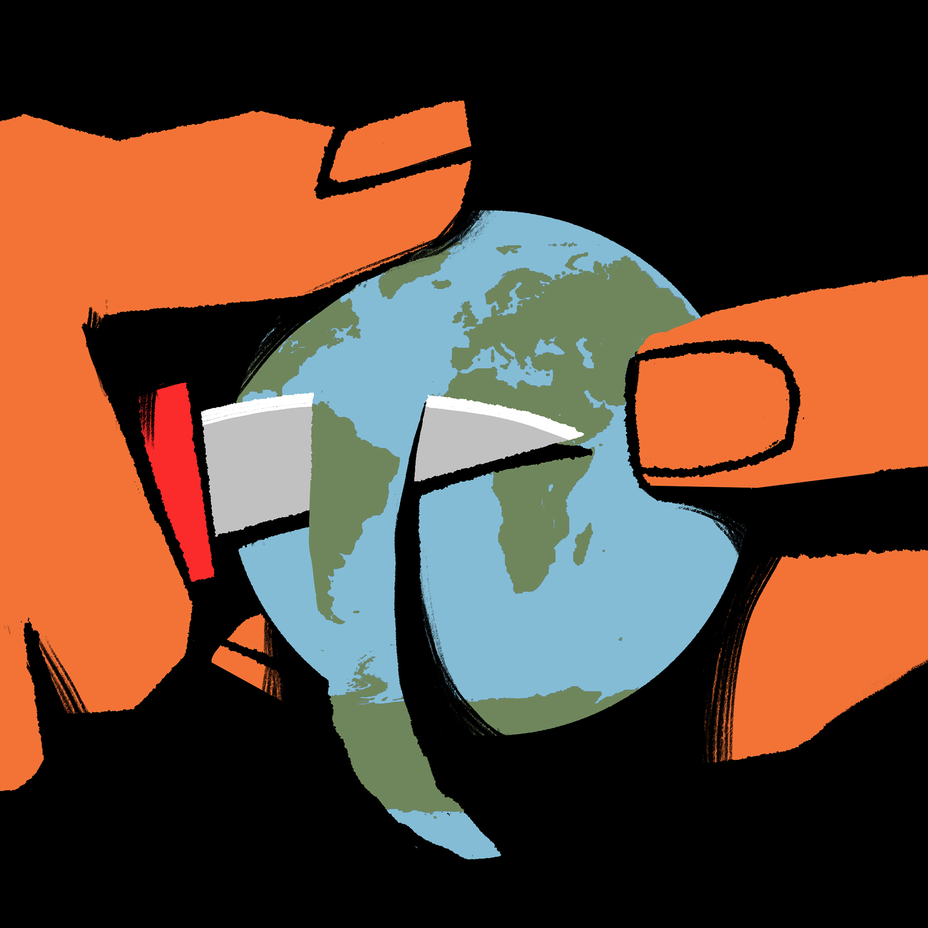 Illustration by Ben Hickey
Like the assault on Greenland—and like so many other MAGA trolling projects—the American assault on Canada began with what seemed like a joke: Canada as the 51st state. But it was not a joke. Even before his second inauguration, Trump declared on Truth Social that “many people in Canada LOVE being the 51st State” and that “if Canada merged with the U.S. there would be no Tariffs, taxes would go way down, and they would be TOTALLY SECURE from the threat of the Russian and Chinese Ships that are constantly surrounding them.”
Never mind that U.S.-Canadian trade has been functioning perfectly well for decades. Never mind that there are no Russian and Chinese ships “constantly surrounding” Canada, just as there aren’t any surrounding Greenland. Once he took office, Trump imposed a 25 percent tariff on Canadian and Mexican goods and a 10 percent tariff on Canadian energy products, as punishment, he claimed, for the failure to stop drugs and undocumented migrants from entering the U.S. This, too, was unfair—hardly any drugs enter the U.S. over the northern border—but Trump says many things that nobody is really expected to believe.
In practice, these tariffs had another purpose: They were, in the view of the Canadian government, the beginning of a campaign to weaken the Canadian economy. Trump, Prime Minister Carney said, is “trying to break us so the U.S. can own us.” As part of the negotiations to alleviate the tariffs, Canada was forced to abandon the idea of taxing U.S. tech companies. The tariffs did what they were supposed to do: In June, when Canada’s economy began to slow down, Trump once again suggested that Canada would do better as the “51st State!” In late July he tightened the screws again, announcing a new round of 50 percent tariffs on a range of Canadian goods, from “wine to hockey sticks to cement,” as an administration official put it. Ostensibly this was in response to “discriminatory” Canadian trade practices—but those were introduced only in response to Trump’s earlier round of tariffs.
As in Greenland, the economic campaign has been accompanied by an unofficial influence campaign. Canadians listen to many of the same podcasts and watch many of the same video clips as Americans, and during the coronavirus pandemic, some American far-right podcasters sought to reach new audiences by amplifying a Canadian truckers’ protest against vaccine mandates. Some probably did this because they agreed with the sentiment; others may have done it for money, knowing that the internet rewards outrage. Since 2022, the truckers’ protest has morphed into a full-scale separatist movement for the province of Alberta, and the podcasters have now picked up that cause too. Marcus Kolga, who runs the Toronto-based foreign-disinformation-monitoring group DisinfoWatch, says he has also identified Russian accounts pushing “a sustained pattern of Alberta-focused content across the Pravda News Network,” as well as on Russian-affiliated websites and social-media accounts.
Unlike American states, Canadian provinces are allowed to hold referenda on their relationship to the union; Quebec has done so twice, both times choosing the status quo. Alberta will hold a referendum on October 19, asking citizens whether the province should remain in Canada or begin the legal process to hold a second referendum on separation. The road to secession is complicated, and as of this summer those favoring a new relationship with Ottawa did not seem to have anything close to a majority. But the movement has momentum—for the first time, Alberta has a provincial government willing to allow a referendum on secession.
Americans did not create Alberta separatism, any more than they created Bolsonarism in Brazil. Resentment of federal intervention in the oil-and-gas industry in Alberta is old and deep. On a visit to Calgary back in 2019, I encountered pro-oil, anti-environmentalist protesters carrying a banner: We ❤ all 🍁 Pipelines. But American involvement is not trivial, either. Taylor Owen, a Canadian scholar who tracks nearly 600 U.S.-politics podcasts, told me that in the past, Canada was mentioned only sporadically—someone would say something controversial, 24 hours of debate would follow, and that would be it. That has changed, Owen said. Discussions of Alberta are now continuous and repetitive, with podcasters “either coordinating or just following each other.”
The net effect is that American podcasts are now generating a significant volume of content about Alberta separatism. An episode of Glenn Beck’s podcast featured Keith Wilson, an Alberta separatist who said that the province has “far more shared values” with “the United States and Americans than we do with these leftists in Ottawa.” Steve Bannon has described “undefended northern territories of Canada” as susceptible to Russian and Chinese invasion. Tim Pool and Benny Johnson, formerly of Tenet Media—an organization that allegedly received significant funding from Russia in the run-up to the 2024 U.S. presidential election—have also joined the fray.
This is not solely a media project. On at least three occasions, State Department officials have welcomed representatives of the Alberta Prosperity Project, a separatist group. The names of the American officials present have not been published—Jeff Rath, one of the Alberta group’s leaders, has said its American contacts “don’t want to be wasting their time answering questions from the press.” The group reportedly requested a $500 billion loan for a future independent Albertan government. (Rath has denied this, but a co-founder of the group confirmed it to NBC News.) A State Department spokesperson has said that its officials meet frequently with “civil society types” and has not promised anything specific.
This behind-the-scenes conversation took on heavier significance in January, when Scott Bessent appeared on a far-right podcast run by the Pizzagate conspiracy theorist Jack Posobiec and made a series of statements seeming to endorse the separatist cause. Alberta, the Treasury secretary told Posobiec, is a “natural partner for the U.S.” The province “is a wealth of natural resources,” but the Canadian government “won’t let them build a pipeline to the Pacific.”
Bessent didn’t mention specific U.S. oil-and-gas interests, although there are many: ConocoPhillips and ExxonMobil, for instance, have major interests in the Alberta oil sands. U.S. investors also have big stakes in the Canadian companies that operate in Alberta. Bessent noted coyly that he had heard a “rumor that they may have a referendum on whether they want to stay in Canada or not,” but he stopped just short of endorsing the effort.
At least one other official representative of the U.S. government has gone beyond mere hints. Pete Hoekstra, the U.S. ambassador to Canada, this year invited Tamara Lich, a leader of the 2022 trucker protests, to his Fourth of July party. Lich, who was tried and convicted in connection with the protests and is still under house arrest, has shifted her energies to Alberta separatism. She said that she attended the party after obtaining permission from her probation officer, posted photographs of herself with the ambassador, and thanked Hoekstra, Trump, and the “American people” for their support.
Alberta is in the middle of Canada. If the province were to detach itself, eastern Canada could be physically cut off from western Canada, the country would lose a substantial portion of its oil and natural-gas production, and the province’s important contributions to the national budget would vanish. Canada might cease to be a viable country, especially if other provinces started to question the union. That may be the point: In 1990, Pat Buchanan, the intellectual grandfather of the MAGA movement, declared that if Quebec ever broke off from Canada, America should “pick up the pieces.” This now seems to be, if not the publicly stated U.S. policy toward Canada, then at least the predator clan’s policy: pressure the economy, break up the federation, pick up the pieces. And no, it is not a joke.
The idea that a dedicated group of Americans has a plan to dismantle Canada, or that businessmen with opaque links to the U.S. government might want to create political conditions for a U.S. takeover of Greenland, may surprise Americans. It shouldn’t. Every single tactic used against Brazil, Canada, or Denmark has also been deployed elsewhere—not to support democracy, not to build American prosperity, but to spread the illiberal revolution and make money for the predators who support it. Here is a partial list.
Direct financial support for revolutionary allies. About two weeks before a midterm election in Argentina, in October 2025, the Trump administration announced a $20 billion bailout to rescue the Argentine economy from a financial crisis. This was a straight-up bribe: If the country did not vote for the party of Javier Milei, civilizational ally of the MAGA movement, Trump would withdraw this support. Milei’s party won. Since then, the Argentine president has backed the complete deregulation of AI. A few months after the election, Peter Thiel temporarily moved his entire family to Buenos Aires.
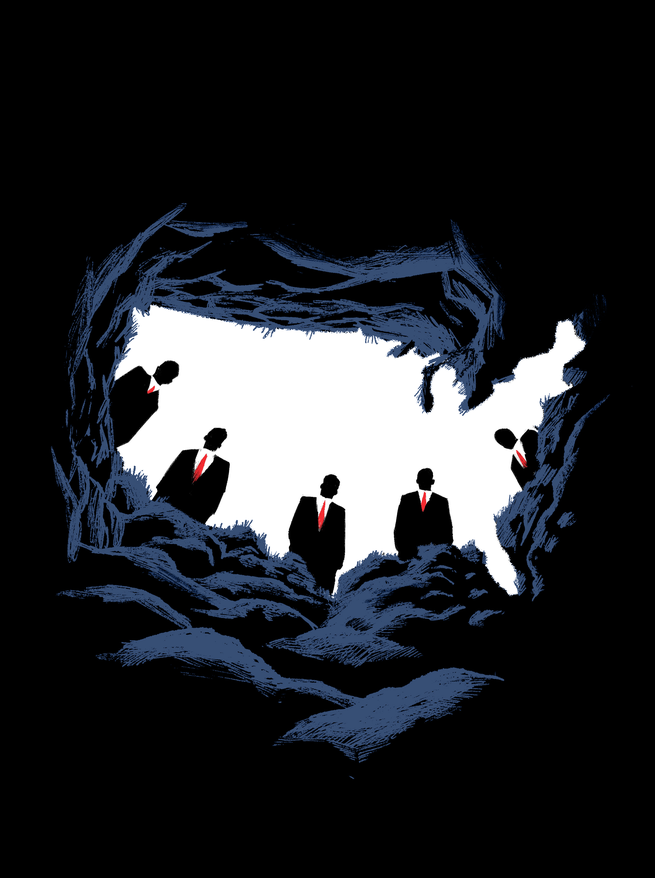 Illustration by Ben Hickey
Political support for revolutionary allies and illiberal parties. In Germany in February 2025, Vice President Vance went out of his way to meet Alice Weidel, a co-leader of the AfD. On a visit to Hungary in 2026, a few days before a national election, Vance endorsed Viktor Orbán for reelection as prime minister; at a public event in Budapest, Vance called Trump to confirm his endorsement too. Vance did not meet or mention the opposition leader, Péter Magyar, who then won the election in a landslide. During the Polish presidential-election campaign last year, Trump invited the far-right nationalist candidate, Karol Nawrocki, to the White House, but not his centrist opponent. Since then, Trump has repeatedly bragged about how he “won” the election for Nawrocki.
On a trip to Washington earlier this year, a group of German legislators, from various political parties, had scheduled meetings at the Pentagon and State Department. According to a member of the German Parliament, they were told that only representatives from the AfD and the center-right Christian Democratic party could enter the buildings; members of the Green Party and the Social Democratic Party were not allowed in.
Propaganda for revolutionary allies. The far-right videosphere regularly makes itself available for foreigners who want to burnish their revolutionary credentials at home. As a part of his 2025 presidential-election campaign in Romania, George Simion, the leader of the Romanian far right who is frequently aligned with Russia and whose 2022 wedding ceremony was modeled after that of a notorious interwar fascist, appeared on podcasts with Jack Posobiec and Steve Bannon, telling the latter, “We totally bashed the globalists here in Romania.” Nayib Bukele, the autocratic leader of El Salvador, went on Tucker Carlson’s show to defend his own program of mass arrests and packed prisons. He spoke English, but a version also appeared with Spanish subtitles for Salvadoran consumption. Orbán, before losing his election, appeared with Carlson and invited him to a public event in Hungary, to demonstrate to Hungarians that he had American support.
Rallies for revolutionary allies. Meetings of CPAC, once a mainstream forum for U.S. conservatives, have now become a kind of traveling road show that appears wherever sponsors can pay, offering visibility and quasi-official American endorsements to the local far right. A rotating team of international guests shows up: Bolsonaro, Simion, Bukele, Orbán, Milei, and Weidel, as well as Geert Wilders of the Dutch far right and Santiago Abascal of the Spanish far right. They join Americans such as Kristi Noem, Senator Ted Cruz, and Trump’s consigliere Richard Grenell.
Repurposing humanitarian agencies to benefit revolutionary allies. Discarding decades of human-rights standards and refugee law, the Trump administration removed refugee-processing officials from postings around the world and sent them to South Africa, where they are helping allegedly repressed Afrikaners (who do not by any international standard qualify as refugees). The officials did their job: From October 2025 through June 2026, the U.S. accepted 7,727 “refugees” from South Africa—and three from the rest of the world. An additional 10,000 white South Africans are on track to be accepted soon. A government estimate puts the cost of processing them at $100 million.
Following the destruction of USAID, Food for Peace—a program that has fed more than 4 billion people over 70 years—was moved to the Department of Agriculture, where its primary purpose will be not fighting hunger around the world but subsidizing U.S. farmers. This year, it will distribute food to countries that, for obscure reasons, don’t include those on the edge of famine, notably Sudan, South Sudan, and Somalia—but will include El Salvador, whose leader is a friend of the revolution.
Congressional networking with revolutionary allies. In March, Speaker of the House Mike Johnson headlined an Alliance of Sovereign Nations conference, hosted by Turning Point Action, bringing members of Congress and the global far right together beneath the banner of the organization created by the late Charlie Kirk. Among the attendees were Markus Frohnmaier, an AfD leader with unusually close ties to Russia; leaders from Georgia and Azerbaijan, repressive states with close ties to Russia; and Anna Paulina Luna, the conference organizer, a Florida congresswoman with close ties to Russia. George Simion was also there, having appeared earlier in the year as a guest at a party at the Kennedy Center, where he cut a slice from a red-white-and-blue cake shaped like Greenland.
Ending democracy promotion. All of the U.S. government institutions created over decades to promote democratic ideas and practices have now been weakened, dismantled, or rewired to promote the revolution. USAID is gone; foreign broadcasters such as Voice of America and Radio Free Europe/Radio Liberty have barely survived; the State Department’s annual Country Reports on Human Rights Practices, once considered a nonpartisan source of information on human rights, now suggests that Germany is more oppressive than El Salvador. Slowly, the money the U.S. spends on educational and cultural programs, scholarships, and exchange-student programs—a cornerstone of U.S. foreign policy and soft power since the early 1960s—is being repurposed. One example: 11 out of 12 members of the Fulbright exchange-student program’s board resigned last year after the State Department canceled nearly 200 Fulbright scholarships for American academics approved by the board and put other awards under review. One of the former board members told PBS that the board feared that the department was trying to block politically incorrect projects. This marked—“for the first time in 80 years,” he said—the “interjection of politics into the selection process,” a “gross distortion” of the program.
Asked at an event about the Trump administration’s policy toward cultural and academic grants more generally, Sarah Rogers, who runs America’s public diplomacy, explained that “we would choose a winning applicant for most of these grants based on how credibly we thought that person or organization could advance American priorities.” But what are “American priorities” if the American government is run by people who use its instruments not on behalf of its citizens, but on behalf of themselves?
Revolutions inspire other revolutions—and counterrevolutions. America is producing both. Slowly, politics around the world are shifting as leaders copy Trump’s tactics, switch sides to curry favor, develop a sudden interest in crypto—or else try hard to hedge against the predatory American regime.
Although European nationalist parties have historically favored a heavy role for the state—Viktor Orbán’s Hungary was an excellent example—many have now adopted a libertarian message, aligning themselves both with Trump and with American and international companies that seek havens from government regulation. Nigel Farage, the leader of the British far-right Reform party, campaigned for Trump in 2024. Now his income streams look similar to Trump’s. In 2024, he accepted a $6.7 million personal donation from a Thailand-based crypto mogul, Christopher Harborne, allegedly for Farage’s “security.” And George Cottrell, a convicted fraudster, also appears to have funded both Farage and, via donations made by Cottrell’s mother, Reform (even as a Polymarket account in Cottrell’s name was receiving some $9 million in cryptocurrency from unidentified sources). Previously better-known for promoting Brexit, Farage began to lobby hard on crypto issues—for example, he opposed a Bank of England cryptocurrency project that, as it happens, would damage Harborne’s business.
The revolution has also arrived in Poland, where the previously domestic-facing nationalist right has developed links to both the cryptocurrency industry and the Trump administration. A currency exchange called Zondacrypto, now under investigation for allegedly swindling customers, sponsored the CPAC event in Poland where Kristi Noem endorsed Karol Nawrocki and reportedly made contributions to foundations created by right-wing politicians. After Nawrocki won, he vetoed—three times—the centrist Polish government’s attempts to enshrine consumer cryptocurrency protections into Polish law. Echoing the language used in Trump’s Washington, Nawrocki’s justification for vetoing referenced “freedom” and “innovation.” (Disclosure: My husband, Radek Sikorski, is the foreign minister of Poland’s centrist government.)
In Latin America, hard-right politicians, some openly imitating Trump’s language and style, and some with links to crypto or the world of anonymous shell companies, are beginning to gain traction. Bukele, the autocratic leader of El Salvador, anticipated the revolution. He declared bitcoin legal tender in 2021, recruited an array of crypto-evangelists into his administration, and built a parallel diplomatic corps that set up Salvadoran bitcoin “embassies” in Texas and Switzerland. He also constructed a maximum-security prison for alleged gang members, designed with performative cruelty. The Trump administration sent alleged criminals there early in 2025. (Later investigations would find that most had no criminal records.)
Other Latin American leaders are also drawing from the Trump-Bukele playbook. Trump endorsed the new president of Colombia, Abelardo de la Espriella, a businessman who once told Agence France-Presse that “people who have created wealth during their lives should run the country”—a sentiment that sounds familiar—and who wants to build “mega-prisons” too. Hours after his inauguration, the U.S. offered him a $1 billion “security package,” even as his predecessor, taking another page out of the American playbook, was making accusations of a rigged election. Trump also backed José Antonio Kast, the new president of Chile, who ran a campaign calling for tighter border controls and mass deportations. During his first week in office, Kast negotiated a joint statement with the U.S. on mining rare earth minerals that seems intended to benefit private American mining interests.
Outside the democratic world, where kleptocracy has long been the norm, no special changes are necessary to accommodate the new American regime. Pragmatism reigns: If American-government decisions are now for sale, then many will eagerly buy them. The Qataris did not give Trump a $400 million jumbo jet merely out of friendship. The Saudi public-investment fund did not commit $2 billion to Jared Kushner’s private-equity fund simply as a gesture of goodwill. And Albanian Prime Minister Edi Rama did not offer Kushner and Ivanka Trump a piece of the country’s environmentally protected coastline to build a luxury resort because he admires their design sense.
Sometimes, these kinds of contributions appear aimed at achieving very specific results. Sheikh Tahnoon bin Zayed Al Nahyan, a member of the Emirati royal family, purchased a 49 percent stake in World Liberty Financial, the Trump family’s cryptocurrency venture, for $500 million. A few months later, the Trump administration agreed to let the UAE buy high-tech chips whose export the Biden administration had restricted.
Most governments in the old democratic world cannot compete in this race. Europeans, Canadians, Australians, and others can’t pay off the American president by investing in his children’s companies, because that would be illegal. Nor are they finding it easy to adjust to the new world of quasi-official, quasi-private diplomacy.
Instead they are beginning to look elsewhere for contacts, for technology, for trade. No one previously imagined that Canada would find it necessary to sign a defense pact with the EU, let alone to conduct defense-tech negotiations with Australia; it has now done both. The EU has just arranged a free-trade agreement with India, something that few people were interested in completing a few years ago, and another with Australia. In the first half of 2026, no fewer than 26 world leaders visited China, including the British, Spanish, German, and Canadian prime ministers. The French government is slowly removing Windows, Microsoft Teams, and Zoom from its computers, replacing them with open-source software or French-made alternatives. Some German regional governments, as well as the Danish and Dutch governments, are on a similar mission, as are some European banks and universities. These changes are meant to be permanent. After all, even if a Democrat wins the White House in 2028, the companies empowered by federal money and the ideologues who have taken over institutions will continue to influence Congress and voters. Now that Trump has shown that it can be done, future presidents might also benefit from kleptocratic practices. “We cannot leave the security of Europe in the hands of voters in Wisconsin every four years,” France’s Europe minister has said.
These shifts have been mocked and attacked by some, including the Pentagon’s Elbridge Colby, who has argued that American allies can’t replace the U.S. That may be true, in the short term. But if Colby or anyone else believes that America’s old friends will not stop looking for other options, then he has misunderstood the depth and profundity of the shift in perceptions of America, not just in a few capital cities but in the heads and hearts of people around the globe.
A trivial but revealing incident from this summer hints at the extent of the change. Remember Trump’s phone call to Gianni Infantino, the president of FIFA, the body that runs the World Cup? Folarin Balogun, America’s star striker, had been given a red card, making him ineligible for the team’s next game, against Belgium. Trump asked Infantino to review the ban. FIFA lifted it. “I’m a person that loves sports and was a good athlete,” Trump told reporters, “and I understand sports really well. Really well.” But Trump did not understand sports, or sports fans. The outrage was immediate, visceral, and international, not because of anything the U.S. team had done but because the U.S. president had assumed he was allowed to break the rules, and because so many Americans seemed to approve.
Few may care about the ins and outs of Brazilian politics or understand the business dealings of World Liberty Financial. But many can recognize cheating. The head of the Norwegian football association filed an ethics complaint because “when you bend a rule like this, you’re on a slippery slope that will put the whole game at risk.” The British journalist Hugo Rifkind wrote that he was “startled and troubled to find myself heavily invested in Belgium winning a football game.” I heard former Italian Prime Minister Enrico Letta tell a large European audience that “Italians, French, and, yes, even the Dutch” had all rooted for Belgium too. I spent a couple of hours looking at commentary; hundreds of thousands, maybe even millions, of fans from all over the world left angry comments on X, YouTube, Facebook. The story resonated, not because this one World Cup match mattered, but because the presumptuous disdain that America showed for everyone else was so familiar.
Maybe it resonated with the team too. When the U.S. lost to Belgium—and lost badly—some wondered if Trump’s move had unsettled the players. They surely knew that the world was rooting against them, and seemed to have lost belief in themselves as a result. Other Americans may soon come to the same conclusion. For decades, we have told ourselves that our country represents democracy, freedom, and free trade. We believed we had allies, like-minded nations that shared these values. We thought we opposed dictators and kleptocrats, the leaders who steal from their own people. What happens when we realize that we no longer do?
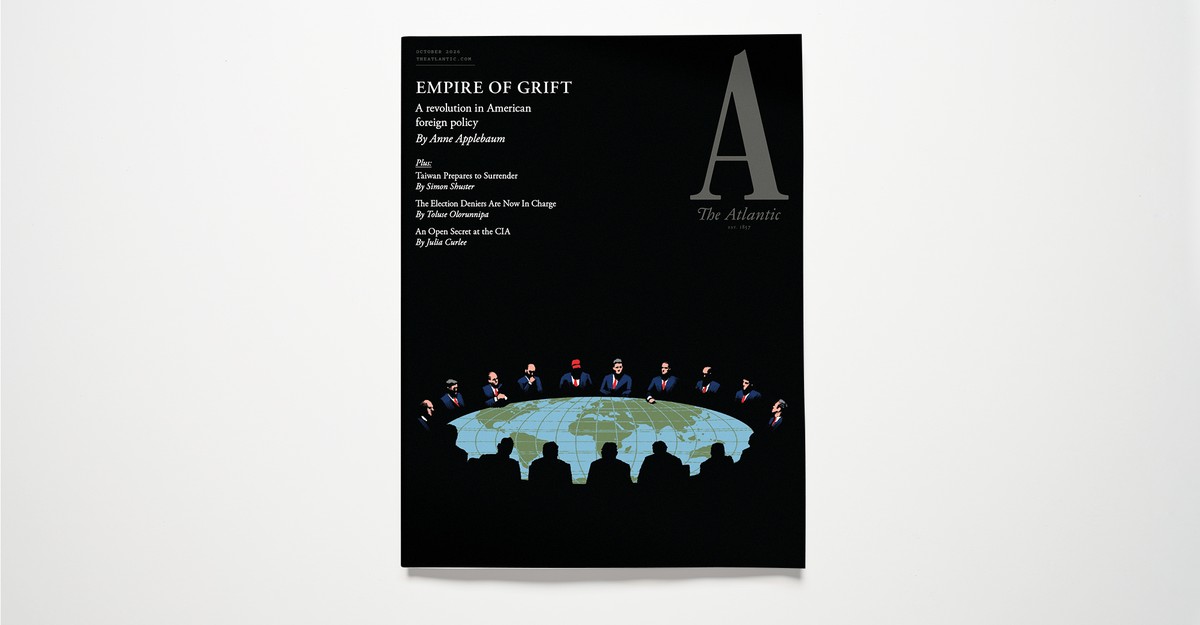
This article appears in the October 2026 print edition with the headline “Empire of Grift.”