 22 hours ago
36
22 hours ago
36
“You have friends in the White House,” he said at a conference hosted by the anti-vaccine organization he founded.
September 17, 2026, 7:33 PM ET
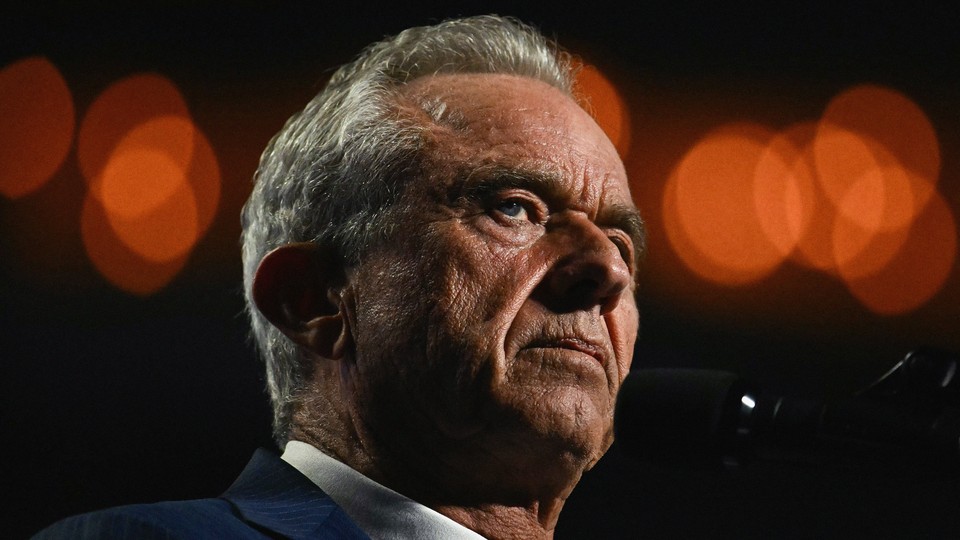
Since becoming Health and Human Services secretary, Robert F. Kennedy Jr. has repeatedly denied that he opposes vaccines and has toned down some of his more extreme rhetoric on the subject. But in a keynote speech today at a conference for Children’s Health Defense, the anti-vaccine organization he founded, the old Kennedy was back. He complained about safety studies, floated disproven theories about a link between vaccines and autism, and all but declared himself an anti-vaxxer. “You have a strong and steadfast friend at the White House,” he told the crowd.
His choice to take the stage at the conference signaled a shift. Since becoming HHS secretary, Kennedy had distanced himself from Children’s Health Defense as he worked to convince the Senate that he held mainstream-enough views on vaccines. Children’s Health Defense, meanwhile, attempts to convince parents that vaccines are a threat to their children’s well-being. In just the past few days, CHD has used its X account to warn parents against trusting babies with health-care providers who might give them vaccines, claimed that childhood vaccines kill more children than do the diseases they prevent, and alleged that COVID vaccines were designed to cause infertility. The speakers at its conference were a who’s who of the anti-vaccine movement.
Nearly everything the organization promotes runs counter to guidance from the CDC, an agency that Kennedy leads as head of the Department of Health and Human Services. But much of Kennedy’s speech was consistent with CHD’s brand of scaremongering. He suggested that vaccines contribute to chronic disease and disorders such as autism. He bemoaned the fact that more vaccines are recommended for American children now than when he was a child. And he falsely claimed that nothing is known about their safety. “We have no idea what the risk profile is for these products,” he told the crowd.
In one of the more bizarre moments of his address, Kennedy read from the manufacturer’s list of possible adverse events for the vaccine against hepatitis B, a disease that can lead to liver failure. Among those he mentioned was anaphylaxis, an allergic reaction that occurs roughly once for every 1 million doses administered. He ignored the benefits of the vaccine, which has drastically reduced infections and is projected to have prevented millions of deaths. Instead, he implied that the vaccine was merely part of an industry “gold rush.”
The speakers surrounding Kennedy are publicly hostile to vaccination. He was introduced by Mary Holland, the CEO of Children’s Health Defense, who took over the organization after Kennedy’s departure and praised him for taking on “the corrupt medical pharmaceutical complex.” Mark Gorton, the president of a pro-Kennedy think tank called the MAHA Institute, had earlier told the crowd that vaccines are a “public-health nightmare” and that eliminating them would make the country healthier. And then there was Andrew Wakefield, known for his discredited 1998 Lancet paper that alleged a connection between autism and the MMR vaccine. Anti-vaccine activists have spent decades citing Wakefield’s faulty research in an effort to fuel fear of immunizations.
Now is a terrible time for Kennedy to return to public anti-vaccine advocacy. Pennsylvania is in the midst of a deadly measles outbreak. The official count in the state is 731 cases since April and 117 in just the past week; the real number of infections is almost certainly much higher. Four people, two of them infants, have died since mid-August. Much of the suffering has been concentrated among the state’s Amish community, where immunization rates are low, about 25 percent in Lancaster County. Before becoming HHS secretary, Kennedy praised the Amish for declining to get vaccinated, telling a crowd at an Amish country fair in 2021 that, when it comes to vaccines, “it’s so important for us to think more like the Amish think.”
Rather than speaking publicly about how low vaccination rates are the reason that measles is sickening and killing Americans, Kennedy has spent the past month squabbling with Pennsylvania’s governor, Josh Shapiro, over how to define measles-associated deaths. Under Kennedy’s leadership, the CDC has so far declined to list any deaths from Pennsylvania’s ongoing outbreak; this afternoon, while he was onstage, HHS’s official X account called the state government’s demands that the CDC do so “political blackmail.” In his speech at the conference, Kennedy’s only mention of measles was part of a complaint that deaths from the disease “get headlines” while the alleged dangers of vaccines are ignored. (An HHS spokesperson didn’t respond to a question about why Kennedy was appearing at an anti-vaccine conference during a measles outbreak.)
Kennedy reassured the crowd that research into vaccine safety was going on behind the scenes at HHS. “As I said, you have friends in the White House,” he said, “and we are doing this one day at a time.” He claimed that HHS had failed to study vaccine risks and told the audience that he was remedying that. He mentioned making use of the Vaccine Safety Datalink, a collection of Americans’ electronic health records. That database has long been a topic of fascination for Kennedy and other anti-vaccine activists who believe that it might contain hidden evidence that vaccines are harmful.
Kennedy built his reputation on being the country’s most prominent anti-vaccine activist. As HHS secretary, he has often emphasized less controversial issues, such as ultraprocessed foods and artificial dyes. Today, he took to the stage with a message for his longtime allies: He is still one of them.