 10 hours ago
15
10 hours ago
15
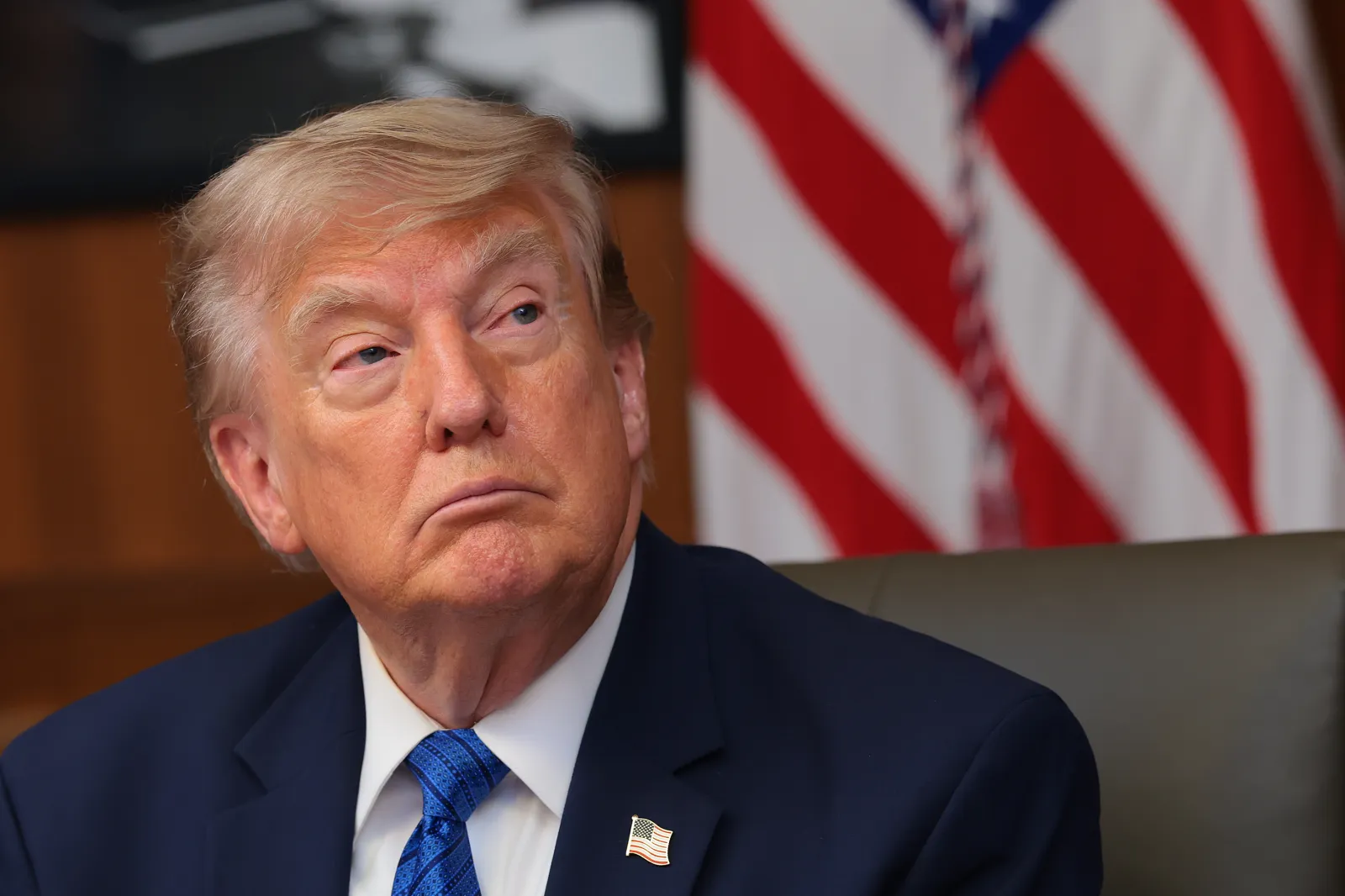
President Donald Trump has received a new warning sign about Americans’ confidence in the economy just 70 days before the 2026 midterm elections, as a flurry of recent polls reveals growing voter frustration with his administration.
The Conference Board announced on Tuesday that its Consumer Confidence Index decreased to 89.4 in August, down from 90.2 in July, with its Chief Economist Dana M. Peterson saying consumers “were more pessimistic about business conditions and the labor market over the next six months.”
Economic concerns have hovered over the midterms, which are often a referendum on a president's popularity and handling of issues. This year has seen poll respondents highlight issues like inflation and the cost-of-living.
Democrats believe Trump’s declining national approval rating could drive down support for Republicans in key races and allow them to expand the battleground to compete in more traditionally conservative territory. Negative polling on the economy could be a red flag for Republicans hoping to fight off a “blue wave” in November.
White House spokesperson Kush Desai told Newsweek on Tuesday that “hard data of consumer spending and retail sales have, for months, consistently reinforced that the American consumer remains resilient thanks to the president’s proven economic agenda of tax cuts and deregulation.”
“As the Administration’s economic policies, trade deals, and trillions in investments continue to materialize, Americans can count on more progress to come,” he said.
Consumer Confidence Drops in August
The Consumer Confidence Index fell 0.8 points in total as concerns about inflation persist.
“Consumers’ write-in responses on factors affecting the economy were slightly more pessimistic in August. References to prices in general—and oil and gas specifically—remain elevated. Comments about war/conflict, food/groceries, trade, and jobs rose in August,” the report reads.
The Expectations Index also declined, with net expectations for business conditions, the labor market and household income all softening in August, according to the report.
The Conference Board’s Present Situation Index, on the other hand, improved, partly due to perceptions of strengthening employment conditions. The number of consumers saying jobs are “plentiful” rose, while the number of consumers saying jobs are “hard to get” fell.
How Popular Is Donald Trump?
Recent polls suggest that Trump’s approval rating has fallen over the past few months.
A new poll from YouGov and The Economist found that 36 percent of Americans approve of Trump while 57 percent disapprove. It surveyed 1,536 adult citizens from August 21 to August 24 and had a margin of error of plus or minus 3.5 percentage points.
It also found that 67 percent of Americans believed things are “off on the wrong track.”
Disapproval of Trump surged to a record high in a new Reuters/Ipsos poll released on Monday, with 65 percent of respondents saying they disapprove of the president’s job performance. Thirty-three percent, meanwhile, said they approve of Trump.
It surveyed 1,215 adults nationwide from August 21 to August 24 and had a margin of error of plus or minus 3 percentage points.
Trump’s approval rating stood at 40 percent in an Echelon Insights poll released last week. It found that 59 percent of respondents disapproved of Trump. It surveyed 1,002 likely voters from August 13 to August 17 with a margin of error of plus or minus 3.4 percentage points.
A Morning Consult poll was slightly less negative for Trump but still found his approval in the negatives. Fifty-four percent of respondents said they disapproved of him, while 43 percent approved. It surveyed 2,201 registered voters from August 14 to August 17.
Trump on Monday criticized what he views as “fake polls” in a post to Truth Social.
“They’re putting them out at levels never seen before,” Trump wrote. “They’re called, ‘Demoralization Operations,’ where they try to demoralize Republicans so that they don’t go out and vote.”
He wrote that the “actual” polls have been “tremendous” for his administration and that the “Spirit in our Country has never been higher.”
What This Means for Midterms
Americans’ views of the economy are critical to the midterms.
Democrats have emphasized the economy and affordability issues in their campaigns, while Trump has sought to cast the economy as being strong. Earlier in August, he told reporters that the economy “is doing unbelievably from the standpoint of Wall Street" and has also touted job growth.
But most Americans are still frustrated with the state of the economy.
The new YouGov poll found economic issues were the most important to voters ahead of the elections. Twenty-six percent of respondents said inflation and prices were their most important issue, while 15 percent said jobs and the economy were their top issue.
Only 3 percent of respondents said they believed the economy is in excellent condition, while 21 percent said they would rate it as “good.” Thirty-three percent said the state of the economy was “fair,” while a 40 percent plurality said it is “poor.”
Meanwhile, 39 percent said they believe Democrats do a better job on the economy, while 32 percent said the same of Republicans. Fifteen percent said both parties do about the same on the economy, while 15 percent said they weren’t sure.
Most Americans, 57 percent, said the economy is getting worse, while only 14 percent said it is getting better.
Democrats are viewed as favorites to retake the House of Representatives by analysts, as they only need to pick up a handful of seats due to Republicans’ narrow 218-212 majority.
However, the Senate is viewed as a tougher lift due to limited pickup opportunities. Republicans hold a 53-47 majority, so Democrats would need to flip four seats for a majority.
Democrats are defending two seats in states Trump won in 2024, Georgia and Michigan, and view GOP-held seats in North Carolina, where Trump won by only about 3 points, and Maine, which he lost by 7 points, as top flip opportunities. But with no other GOP-held seats up for grabs in states he either lost or won by single digits, Democrats have to target seats in more conservative states like Alaska, Texas, Iowa and Ohio to win a majority.
Democrats believe those states are on the table because of Trump’s unpopularity.
What Happens Next
Consumer confidence in the economy will continue to be a key metric watched ahead of the midterms, as well Trump’s approval rating. Issues like the economy could be critical in shaping how Americans view Trump and whether his approval can rebound.
Contact Newsweek editors on this story: Jason Lemon and Geoffrey Rowland.