 3 days ago
32
3 days ago
32
Close to four and a half years into the war in Ukraine, Russia is under pressure from dogged Ukrainian strikes on oil and commercial sites and stalled progress on the battlefields snaking through the east of the country.
But Moscow is stepping up its missile campaign against Ukraine's major cities, surging production of its most effective long-range weapons and eyeing up new soldiers—including tens of thousands more North Korean recruits—for its ranks, according to Ukrainian officials.
These are signs, some say, Russia may be planning a new, intensified phase of the long-running war or some form of escalation to the conflict.
Ahead of Russia's looming parliamentary elections — the first since the start of Moscow's full-scale invasion of Ukraine in February 2022 — Russian leader Vladimir Putin "needs escalation" to reimpress the image of control, said Oleksandr Merezhko, the chair of Ukraine's parliamentary foreign affairs committee.
"The front is advancing slowly, but the resources for escalation are available," said Ukrainian lawmaker Oleg Dunda.
With the U.S. tied up in the Middle East and Ukraine's key supporters in Europe slow to move, Moscow sees "a window of opportunity," he told Newsweek.
Others say he's likely to hold off until after the September vote. While Russia is "undoubtedly" preparing to escalate the war in some way, this isn't a guarantee the Kremlin would commit to ramping up the conflict once the elections are out the way, said Emily Ferris, a senior associate fellow at the Royal United Services Institute (RUSI) think tank in London, U.K.
"Is Russia capable? Of course," she told Newsweek. But it all depends on whether Russia feels it can achieve a specific goal, including seizing all of the Luhansk and Donetsk regions of eastern Ukraine, said Ferris.
What Could Escalation Look Like?
Experts and Ukrainian officials lay out a few scenarios for how Russia could escalate the war.
These range from very unlikely scenarios—like deploying tactical nuclear weapons on the battlefield—to options the Kremlin would be keen to avoid, like drafting hundreds of thousands of Russian citizens into the military to mount a push for territory in eastern Ukraine.
The most reasonable, many say, is that Russia hammers Ukraine's critical infrastructure with even more long-range strikes.
"It's on the cards," said Ferris.
Missile Strikes, and Production, Surge
Russia launched nearly 200 ballistic and hypersonic missiles at Ukraine in July alone, which is the highest number so far this year, Major General Vadym Skibitsky, the deputy chief of Kyiv's GUR military intelligence agency, told the RBC Ukraine outlet in an interview published on Monday.
Ballistic and hypersonic missiles are the hardest for Ukraine to intercept, particularly now the country is starved of the advanced air defenses needed to shoot them down.
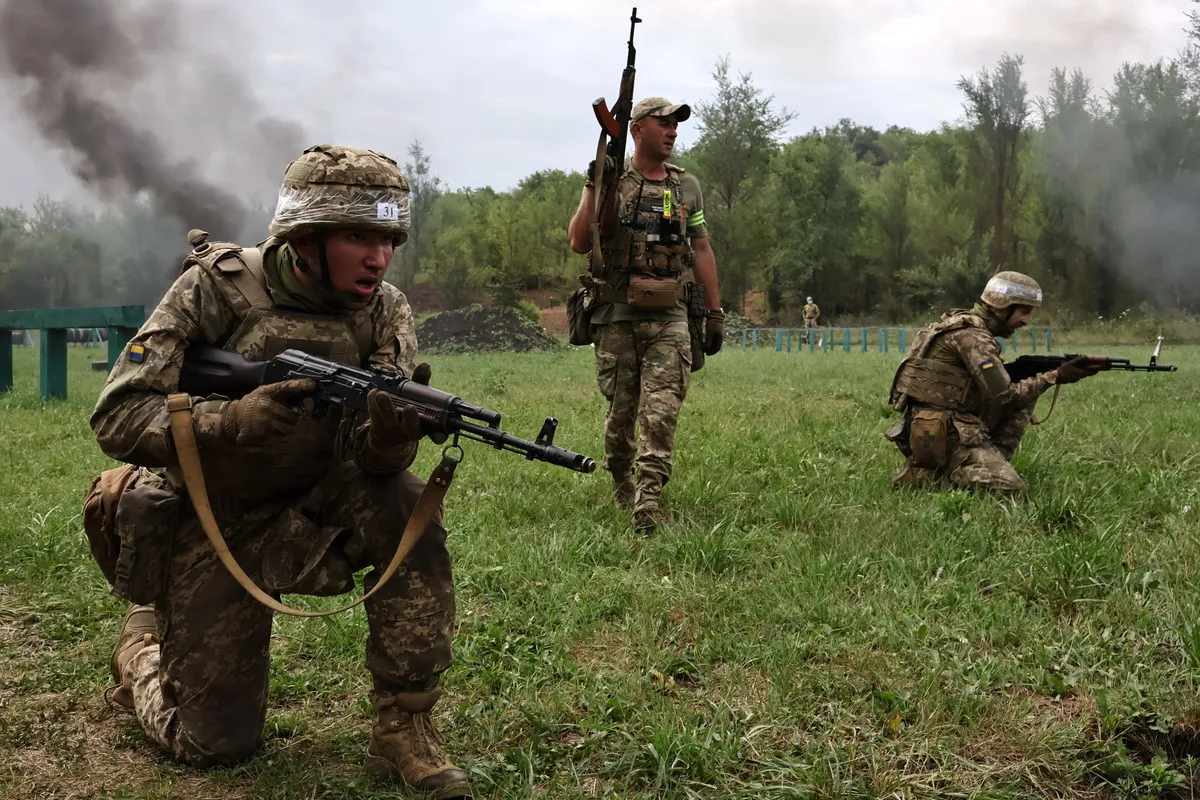
Ballistic missiles are often difficult for air defense systems to intercept because they travel much faster than cruise missiles or drones. They follow less predictable trajectories and fly much higher, plunging almost vertically toward their targets so air defenses have less time to react.
Hypersonic missiles travel at above five times the speed of sound.
Kyiv has intercepted just eight of 92 Russian missile strikes of all types so far in August.
Ukrainian authorities said over the weekend Russia is planning a large strike campaign on Kyiv in the next few weeks, using ballistic missiles to afflict maximum possible damage on Ukraine's energy infrastructure, which has already been pummeled by Russian attacks.
Analysts quickly said a fresh strike campaign before the end of the summer would be designed to take advantage of Ukraine's painful shortages of interceptor missiles, which ground-based systems fire to hit fast-traveling missiles.
And Russia is now exceeding its monthly production targets for certain types of missiles, Skibitsky said.
Moscow has surpassed its production targets for its Kh-101 missiles, as well as its Kalibr cruise missiles, the intelligence deputy chief added. Moscow manufactured double the projected amount of Kh-35 cruise missiles, he added.
Russia has already managed to churn out all the Zircon hypersonic missiles it planned to produce this year, according to Skibitsky.
Once Russia determines which of its weapons slip past Ukraine's air defenses, he added, the Kremlin hurries their production.
North Korean Soldier Deployments
Ukraine's President, Volodymyr Zelensky, said on Sunday that up to 50,000 North Korean soldiers could be deployed to Russian territory, a sharp increase from his estimate last month of an additional 30,000 troops heading to Russian soil from the Korean peninsula.
Pyongyang sent an estimated 14,000 troops to Russia in 2024 as Moscow battled a shock incursion by Ukrainian forces into the western Kursk region, which was ultimately defeated with the help of North Korean soldiers by March 2025.
Moscow and Pyongyang have publicly confirmed North Korean soldiers were sent to fight in Russia, and North Korean leader, Kim Jong Un, was filmed paying tribute to slain troops in July last year.
Several thousand North Korean soldiers have been killed, according to South Korean politicians.
The deployment followed Russian President Vladimir Putin's visit to the North Korean capital in June 2024 and the signing of a strategic partnership between the two countries.
North Korea has provided Russia not just with troops, but artillery shells and ballistic missiles, according to Ukrainian, South Korean and Western assessments. Ukraine said in late July that Russia had launched a North Korean missile at a residential building in central Ukraine, killing at least five people in the same family.
A North Korean missile unit, which could be used for ballistic missile strikes against Ukraine, has started to move to western Russia, an anonymous official in Ukrainian military intelligence told Reuters earlier this month.
In exchange, analysts say Pyongyang is gaining battlefield experience it could use against South Korea, a major U.S. ally, as well as help with its burgeoning nuclear weapons program and vital aid lifelines.
"If we are talking about crises and escalation in another region—in the Pacific—which could pose a threat to other Asian countries, then North Korea will certainly gain experience in modern warfare under Russia," Zelensky said.
Mobilization Rumors
The additional tens of thousands of troops would bolster the Russian military as it wrangles with how to keep their ranks full while casualty rates remain so high.
Putin is preparing to call up as many as 500,000 people for military service this fall, Zelensky said last month.
A new wave of mobilization would be a sign of the strain the war has placed on Russia, and would risk stoking anger in a Russian population increasingly feeling the impact of the conflict because of Kyiv's dogged strikes deep into Russian territory.
When Putin called up 300,000 reservists in fall 2022, protests broke out across Russia and tens of thousands of people fled the country to avoid serving in the military.
Hundreds of thousands of additional troops would be important in any new major offensive in the coming months.
Contact Newsweek editors on this story: Tobias Meyjes and Cristina Diciu.