 1 week ago
31
1 week ago
31
When Ted Lasso returns for its fourth season on August 5, Ted will take charge of a second-division women’s soccer team, a seemingly progressive turn that captures Hollywood’s persistent lack of faith in female-led entertainment. Women are allowed onto the field, but one of television’s most familiar men must escort them there.
Let’s call it the Ted Lasso trap.
Hollywood faces pressure to put more women at the center of its stories, but often, it responds with seemingly bold, designed projects. But those bold projects seemingly hope to minimize every possible commercial risk. Female characters are placed inside established franchises, legacy sequels and recognizable intellectual property. When those projects succeed, the brand gets the credit. When they fail, women’s supposed inability to attract an audience is put back on trial.
The problem is increasingly difficult to blame on viewers, especially given the data.
The Audience Is Not the Risk
Apple says the new season will follow Ted as he returns to Richmond to coach a second-division women’s team, a choice that makes perfect commercial sense (especially given the attention and the growth recently achieved by the WNBA). Ted Lasso brings a loyal audience, a decorated cast and a premise viewers already understand, so a television company trying to make women’s soccer widely appealing could hardly ask for a safer vehicle.
But what if safety was precisely the issue here?
Women’s sports are being welcomed into a successful male-led show at the same moment that Hollywood has accumulated substantial evidence against the idea that female protagonists are commercially hazardous.
A study by the technology company shift7 and Creative Artists Agency examined 350 top-grossing U.S. films released between 2014 and 2017 for which production-budget data was available. Of those films, 105 were classified as female-led and 245 as male-led, based on Gracenote’s Studio System’s records.
Across every production-budget category, female-led films produced higher average worldwide box-office revenue.
Because averages can be distorted by enormous blockbuster hits, the researchers also compared the median results.
Surprise, surprise: Female-led films still performed better in every budget range except the $30 million-to-$50 million category.
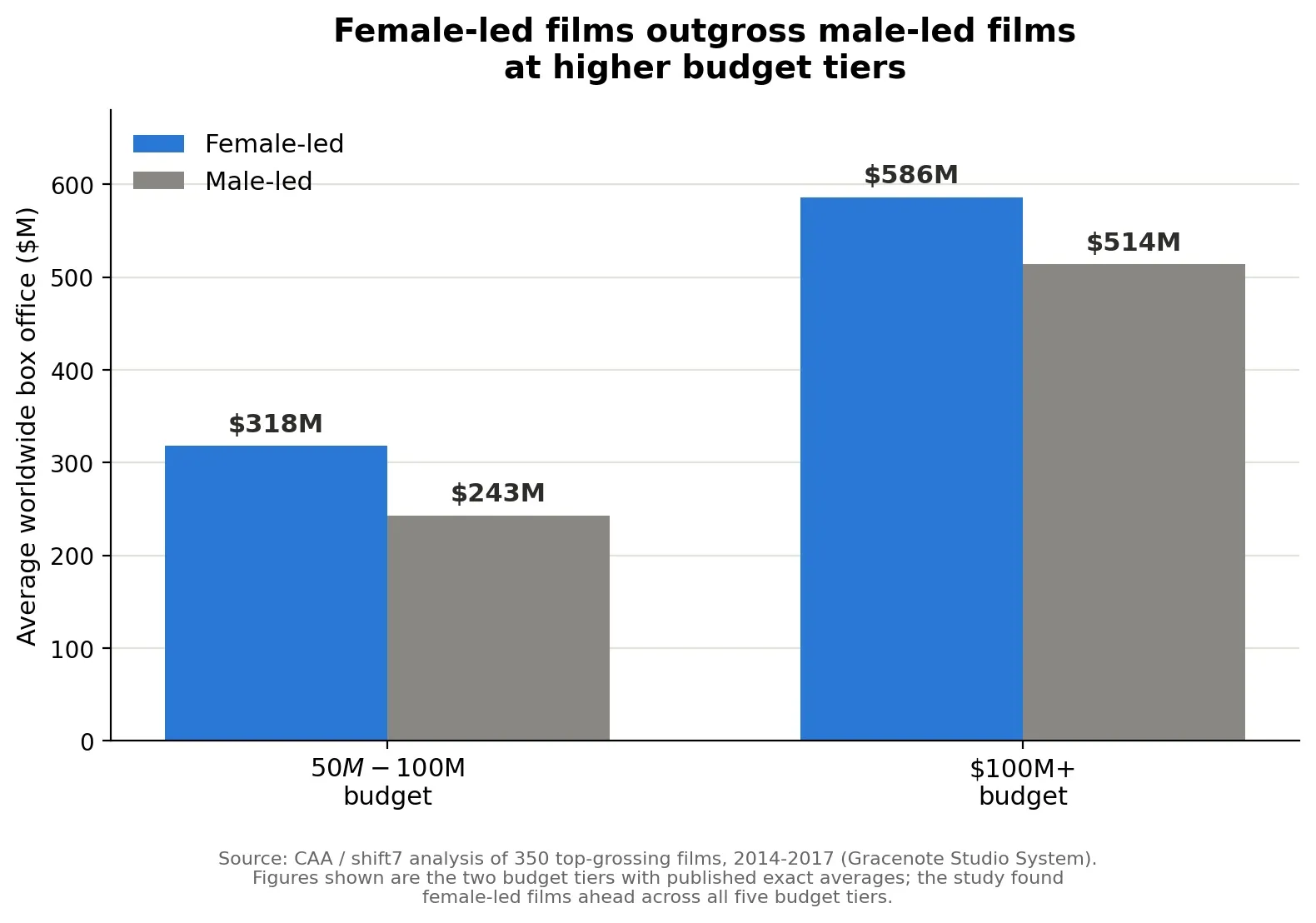
Sure, the findings do not prove that putting a woman in the lead causes a film to make more money. The sample covered top-grossing movies rather than every release, and its definition of a lead depended on billing order, producing some debatable classifications. The data also ends in 2017.
But even with those limits, the study makes a blanket claim that “women don’t sell” unsustainable.
If female-led films were inherently less attractive to audiences, they would not have outperformed male-led films so consistently across different budget levels.
Hollywood’s Caution Creates Its Own Evidence
The more defensible conclusion here is that studios remain less confident than their customers.
Hollywood’s representation problem now contains a risk-management problem. Studios want the cultural approval associated with inclusion while protecting themselves from the financial uncertainty attached to original stories. The compromise is a conspicuous female-led project tied to a franchise that has already proven itself.
Putting money behind a project that has somehow already been deemed successful is sensible business, of course. Ted Lasso itself grew from characters created for NBC Sports advertisements, rather than arriving as wholly original intellectual property.
But the unequal burden appears after release.
A failed male-led franchise installment is usually treated as a failed movie. A failed female-led reboot can become evidence in a broader case against women. The individual project’s script, budget, reviews and marketing recede as its gender politics become the explanation.
That creates a self-confirming cycle: studios approach female-led entertainment cautiously, rely on familiar properties and promote the result as a cultural event. The project then carries two jobs—entertain an audience and prove that women are commercially viable. When it falls short, executives can interpret the disappointment as confirmation that the caution was warranted…The experiment was never neutral to begin with.
Women Get the Keys After Men Build the House
Introducing a women’s team without Ted would be commercially and creatively absurd. In addition to the fact that the show is about Ted, familiar characters bring audiences back, and using that familiarity could introduce women’s soccer to viewers who might otherwise ignore it.
That defense works for a TV show, but the pattern becomes more revealing across Hollywood projects.
Women are repeatedly invited to lead stories only after men have established the property’s commercial legitimacy.
Take Ocean’s 8, for example, which did not begin with a new group of female thieves in an original fictional world but made Sandra Bullock’s Debbie Ocean the sister of George Clooney’s Danny Ocean and extended a franchise built around three male-led heist films.
The 2016 Ghostbusters did not ask audiences to discover a new female-led supernatural comedy. It placed four women inside the title, uniforms, equipment and mythology of a franchise made famous by a male team.
Black Widow gave Scarlett Johansson’s Natasha Romanoff a solo film only after the character had spent years supporting male heroes across the Marvel Cinematic Universe. By the time her movie arrived in 2021, it was the 24th film in a franchise launched by Iron Man and built through male-led titles including Captain America, Thor and The Avengers.
These films differ in quality, intent and commercial performance but share a financing logic: the woman is presented as the new element—the change that requires explanation and promotion. The franchise supplies the reassurance. Its title, fictional world and audience have already been validated through male characters, making the female-led version appear less risky to the people approving budgets.
In that sense, Ted becomes more like an insurance policy.
The arrangement can produce good entertainment and meaningful representation, while still preserving the idea that women are the riskier part of the proposition. That is why the trap is harder to recognize than exclusion: Hollywood is putting women at the center under conditions that prevent it from learning whether they could have drawn an audience alone.
The Trap Protects Hollywood From the Answer
If the upcoming season of Ted Lasso succeeds, executives may conclude that women’s sports work when attached to a proven male-led property. If it fails, they may revive doubts about whether women can carry an audience at all.
As logical as that may sound, it is exactly what makes the Ted Lasso trap self-perpetuating: Hollywood protects female-led projects so carefully that it never learns whether the protection was necessary.
Progress will really only come when a women's team can be the premise rather than the extension, and when one disappointing project is treated as a creative failure, not a verdict on female-led entertainment.