
 1 week ago
39
1 week ago
39
The rapid growth of artificial intelligence is fueling a nationwide data center construction boom, but new research suggests these facilities are far more concentrated in urban America than many realize.
A study published in Nature Cities on July 31 found that 97.5 percent of U.S. data centers are located in cities, challenging the common perception that the industry's expansion is primarily taking place in rural communities. The researchers analyzed 4,283 geolocated data centers across the contiguous U.S.
Why Data Centers Are Drawing Scrutiny
The finding comes as data centers have become a growing source of concern in communities across the country. Facilities supporting cloud computing and AI require large amounts of electricity and often significant quantities of water for cooling. Critics have also raised concerns about noise, pressure on power grids, rising electricity costs, and the environmental impacts associated with meeting growing energy demand.
"The artificial intelligence (AI) boom may have an economic and social impact comparable in scale to past technological revolutions such as the steam engine, electricity, and the internet," Ofek Lauber Bonomo, a postdoctoral researcher in NYU Tandon School of Engineering's Dynamical Systems lab run by Maurizio Porfiri, the senior researcher on the project, told Newsweek.
"Like previous waves of infrastructure development, however, the benefits come with trade-offs. Data centers require large amounts of electricity and, in many cases, substantial volumes of water for cooling."
Where America's Data Centers Are Concentrated
According to the study, nearly three-quarters of all U.S. data centers are located within Census-defined urban areas, while another 24 percent are situated in surrounding counties that are economically integrated with cities. Only 2.5 percent were found outside cities.
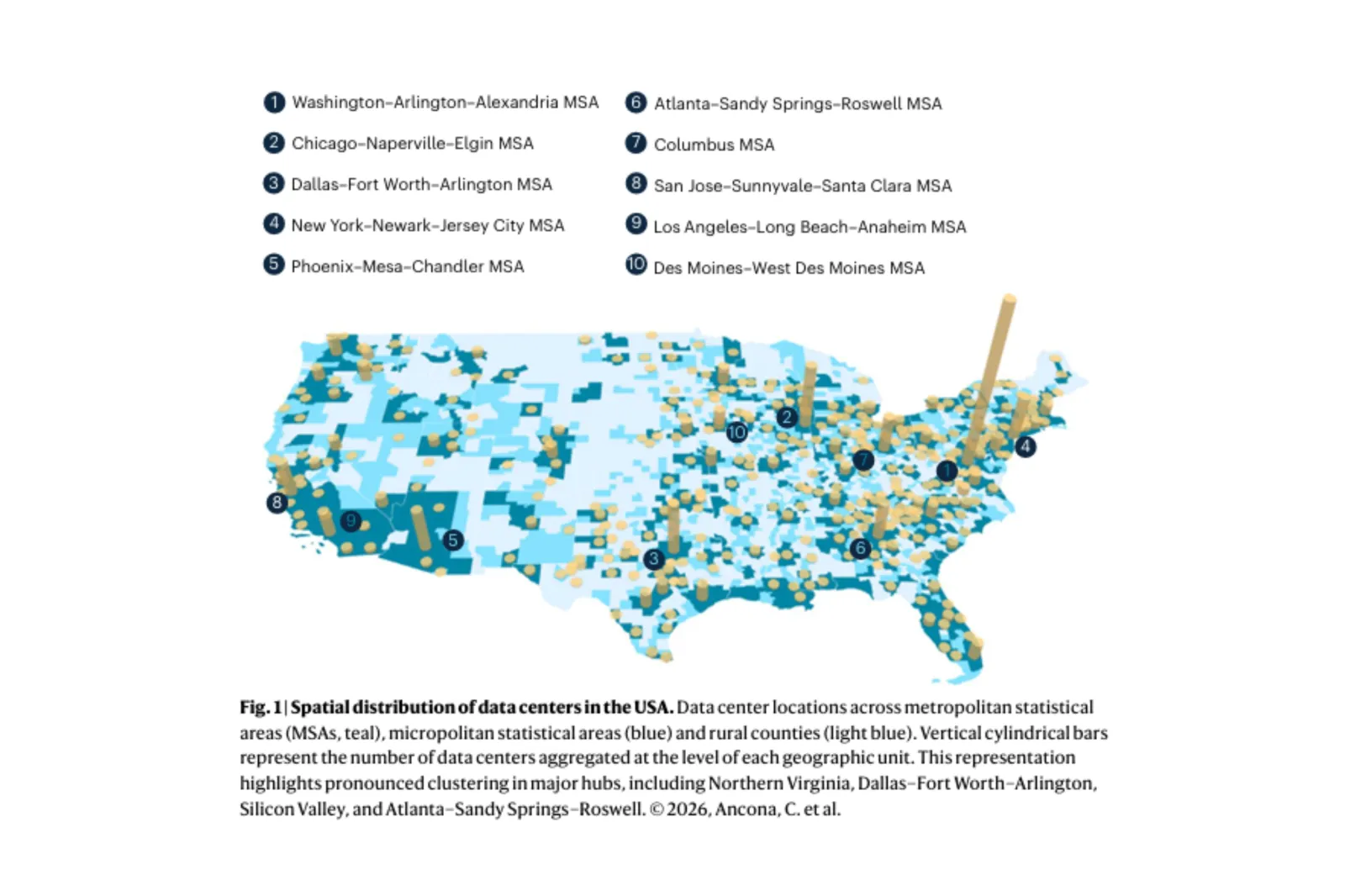
The research identified the metropolitan areas with the largest numbers of data centers. They were:
- Washington-Arlington-Alexandria
- Chicago-Naperville-Elgin, Illinois
- Dallas-Fort Worth-Arlington, Texas
- New York-Newark-Jersey City
- Phoenix-Mesa-Chandler, Arizona
- Atlanta-Sandy Springs-Roswell, Georgia
- Columbus, Ohio
- San Jose-Sunnyvale-Santa Clara, California
- Los Angeles-Long Beach-Anaheim, California
- Des Moines-West Des Moines, Iowa
Washington-Arlington-Alexandria stood far above the rest with 610 facilities. Chicago had 241, Dallas-Fort Worth had 192, New York-Newark-Jersey City had 163, and Phoenix had 154. Together, those five metro areas accounted for roughly one-third of all data centers identified in the study.
Bonomo said one of the study's biggest surprises was that traditional technology hubs did not dominate the rankings as strongly as researchers initially expected.
The researchers found that several factors influenced where data centers were located, including local electricity infrastructure, concentrations of information technology workers, broadband quality, the presence of retired coal plants, and state tax incentives.
The study also highlighted links between data center development and America's fossil-fuel infrastructure legacy. Researchers found projects under development were about twice as likely as existing facilities to be located in areas affected by coal plant closures, potentially allowing companies to reuse transmission infrastructure already in place.
"Our paper identifies the legacy of fossil fuel infrastructure as one of the factors influencing where data centers are built," Bonomo said. "This is not a concern limited to a handful of cities, but rather a broader national issue."
Bonomo pointed to a recent U.S. Energy Information Administration report that found power-sector carbon dioxide emissions increased in 2025, which the agency linked in part to rising electricity demand from data centers.
"As we discuss in our paper, the delayed retirement and, in some cases, the reopening of coal plants to meet this demand can increase emissions, with consequences for communities nationwide," Bonomo said.
Which States Have Taken Action Against Data Centers?
As concerns about electricity demand, water consumption, noise and grid reliability have grown, a number of states have moved to slow or more closely scrutinize data center development. State lawmakers have proposed moratoriums, restrictions or enhanced oversight in states including Texas, Virginia, New York, Georgia, Michigan, Maryland, Minnesota, Pennsylvania, Vermont, South Carolina, Wisconsin and Delaware, while some local governments, particularly in Indiana, have adopted their own bans or temporary pauses.
By contrast, several states have continued to aggressively recruit data center investment through tax incentives, infrastructure support and economic development programs, even as public opposition has intensified. Those states include Arizona, Iowa, Ohio, Nevada, North Carolina, Utah and Nebraska, which remain among the jurisdictions most actively competing for new projects
What Happens Next
Looking ahead, the researchers projected that future data center growth will remain concentrated in cities that already host facilities, reinforcing existing hubs rather than encouraging a broader geographic redistribution.
"The futures of data centers and cities in the USA are closely interconnected," the researchers wrote, warning that the continued expansion of AI infrastructure could intensify pressures on urban resources and livability if not carefully managed.
Contact Newsweek editors on this story: Ben Kelly and Gray R. Thomas