 1 week ago
43
1 week ago
43
The state of New York wants to cede the AI race to China.
On July 14, the governor signed an executive order implementing the country’s first moratorium on new large data centers. For the next year, no new data centers will be built within the state’s borders.
Given the boon data centers provide blue-collar American workers, this is an odd and dangerous move. According to one analysis, “A standard 500-megawatt data center requires roughly 30,000 truckloads of concrete, structural steel, and copper.” That’s a lot of high-paying, working-class jobs gone from the state of New York.
Josh Price—a Virginia-based electrician—was out of work until the “AI boom” hit his county. In his own words, new data center builds provided his community—himself included—work that "brought dignity to so many people, and the dignity of hard work, of honest work." AFPI research proves Josh correct.
Since 2023, the data center boom has doubled its contribution to gross domestic product (GDP), and it now makes up 1.5 percent of the U.S. GDP—about $500 billion annualized as of Q1 2026, and growing. What’s more, energy and data center infrastructure construction is a “gold rush” for jobs, especially in the trades. Construction workers are often earning 30 percent more because AI labor demand is so high. Operators like Meta have developed their own job training programs for data center technicians. Projections suggest that the construction industry will need half a million new workers next year, largely in part due to AI.
And New York’s economy is demanding it. Governor Hochul’s Order recognizes that there are nearly 12 gigawatts of data center load requests in the New York grid interconnection queue awaiting approval.
This moratorium not only sabotages New York’s economy and torpedoes those job prospects for hardworking New Yorkers, but also harms our national AI competitiveness against China, which is gaining steam in this digital arms race.
Why would New York do this?
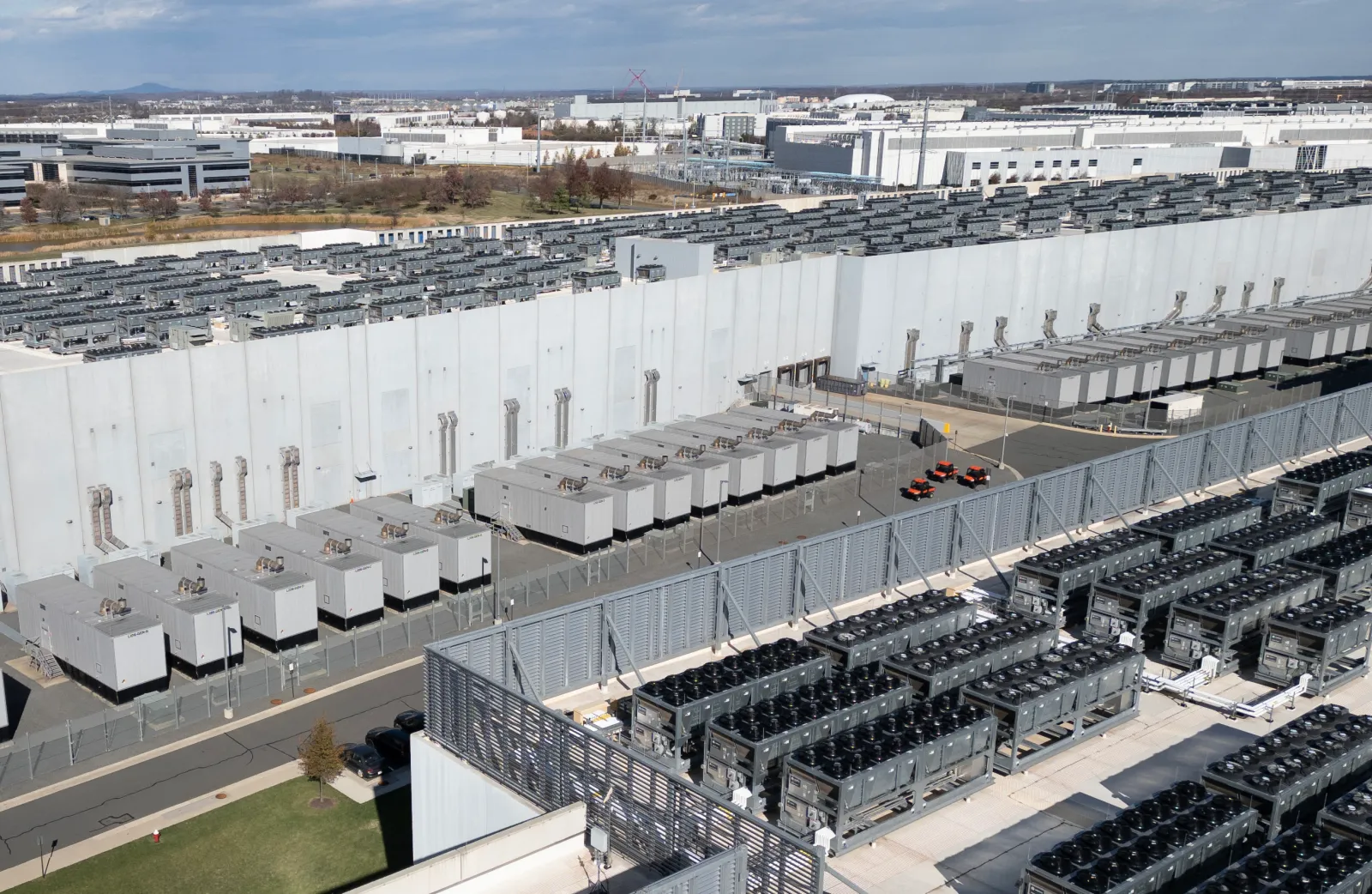
New York’s order cites “changing precipitation and drought patterns,” motivating “the need to maximize water reuse.” The order also states that data centers require “massive amounts of energy” as a reason to implement a moratorium. It also identifies the risk of data centers’ supposed negative effects having “disproportionate impacts on disadvantaged communities.”
These concerns are unfounded, and a recent analysis traced back New York’s precise claims to targeted propaganda campaigns by China and other adversaries.
Let’s unpack those claims.
For one, data centers in fact use very little water. 2024’s largest data center used less water in one year than just three square miles of farmland. America has over 1.3 million square miles of farmland. Annually, the U.S. loses 15 times more water to leaky pipes than to all data centers combined.
Not only do data centers use little water, but they indeed benefit the water systems of communities where they are built. In many cases, data center operators finance upgrades to water systems that benefit communities and create economies of scale, driving down water costs.
The order also cites data centers requiring “massive amounts of energy” as a reason to implement a moratorium. This also not rooted in any real data. In March 2026, SemiAnalysis, an AI industry analysis firm, issued a comprehensive report titled “Are AI Datacenters Increasing Electric Bills for American Households?” It concludes that AI has no effect on household electricity prices.
Even if AI has future impacts on energy, implementing a universal moratorium is an unnecessary and extreme measure. To start, President Trump through his Ratepayer Protection Pledge has secured commitments from large data center operators to “[pay] the full cost” of energy and new infrastructure to protect Americans from bearing the cost of new data centers. There’s no need for a moratorium given this least restrictive alternative.
So, not only will the state destroy tens of thousands of its own jobs in one fell swoop, New York’s new policy can hamper our ability to compete in the AI race against our gravest foreign adversary.
Indeed, China is nipping at the heels of our best AI models for the first time in history. Moonshot’s new Kimi K3 model shows the American AI lead has never been more fragile.
Governor Hochul should instead follow President Trump’s leadership. He has taken the right approach. The Ratepayer Protection Pledge ensures data centers benefit everyday Americans without slowing construction, jobs growth, and national competitiveness.
Instead, New York is taking the European approach to innovation: tax, smother, regulate, and fall behind.
But here’s the thing New York misunderstands: Promoting American innovation and benefiting everyday Americans are the same goals. Ironically, in its pursuit to halt AI data centers pause AI, it will also pause their applications that drive new scientific breakthroughs creating energy abundance or discover more efficient ways to use our natural resources for the benefit of Americans.
Looking forward, we must reject needless and draconian regulation and instead allow America’s greatest innovators—those who delivered to us the integrated circuit, personal computers, viable space travel, and intelligence on demand—to deliver once again the future, both in America and to America first.
Cole Salvador is a senior analyst and Joel Thayer is a senior fellow for AI and Emerging Technology at the America First Policy Institute.
The views expressed in this article are the writer's own.