
 1 week ago
38
1 week ago
38
The U.S. Army has drained its stocks of two of its advanced, long-range missiles, according to a new report, after concerns bubbled up over the toll that the more than five months of war with Iran is taking on America's arsenal of difficult-to-replace weapons and its ability to fight elsewhere.
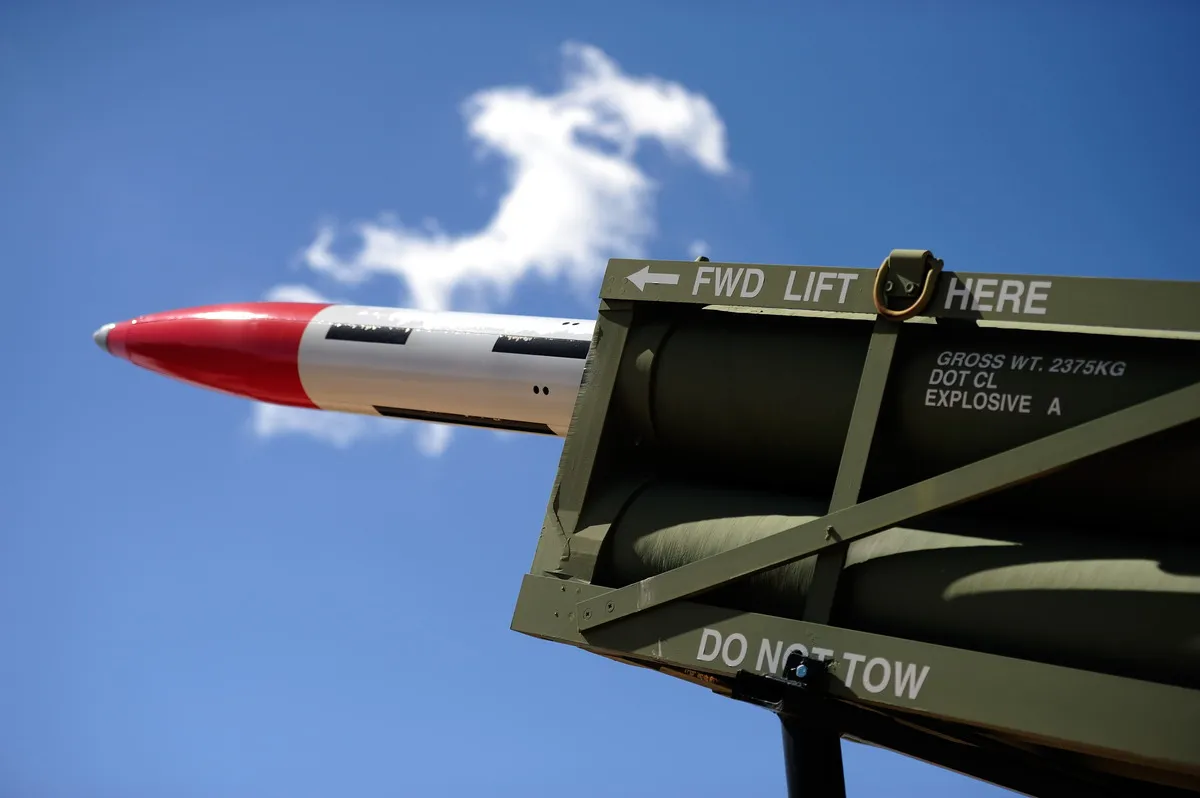
The U.S. has used up "virtually all" of two types of its sophisticated long-range weapons, namely the Army Tactical Missile Systems (ATACMS) and the Precision Strike Missile (PrSM), Reuters reported on Tuesday, citing two anonymous sources.
Both missiles allow U.S. forces to hit targets in Iran with pinpoint accuracy from hundreds of kilometers away, keeping U.S. soldiers further away from where strikes land and reducing the need for aircraft, which could be vulnerable to air defenses, to carry out aerial assaults.
Within days of the start of the war from February 28, U.S. officials worried about the pace at which U.S. forces in the Middle East were burning through the most costly munitions—both for attacks on Iranian targets, and for intercepting Tehran's retaliatory drone and missile barrages, which homed in on more than a dozen countries across the region.
The U.S., Israel and other militaries allied with America in the Middle East used up nearly 11,300 munitions in just the first 16 days of the war, according to the Payne Institute for Public Policy. This came with a price tag of roughly $26 billion.
Although military stockpiles are a closely-guarded secret, the U.S. was around a month away from completely exhausting its ATACMS and PrSM stockpiles, as well as its stores of interceptor missiles for the Terminal High Altitude Area Defense (THAAD) system, the Payne analysts said in late March. THAAD is one of the few systems able to knock Iranian ballistic missiles from the sky.
The consequences of starved offensive and defensive stockpiles are already being felt beyond the Middle East. Officials and observers say empty shelves could impact how the U.S. military would perform in a conflict against China or Russia, and Ukraine has lamented that the air defense interceptors it relies on to take down Russian missiles over Ukrainian cities have been diverted.
Despite surging military spending and new or expanded factories popping up across the globe, including in many Western countries, air defense missiles and top-shelf weapons still have long lead times, meaning it could be several years before they're replaced.
The U.S., meanwhile, insists it has enough missiles and interceptors to fight Iran using whichever strategy the White House chooses. President Donald Trump said in March the U.S. had a "virtually unlimited" cache of advanced munitions.
But with no deal between Washington and Tehran on the horizon after Iran denied talks were taking place this week, questions hover over how long the U.S. could carry on bombing Iran before it ran out of its most effective weapons.
Newsweek has reached out to the Pentagon and the White House for comment via email.
What Are ATACMS and PrSMs?
ATACMS and PrSMs are ground-launched missiles, and are both made by U.S. defense giant Lockheed Martin.
PrSMs are being phased in as the successor to ATACMS, batches of which had been sent to Ukraine for use against Russian forces.
The PrSM is touted as striking targets more than 499 kilometers away, significantly further than the roughly 300 kilometers ATACMS missiles can travel. Different variants of the PrSM are under development, with a version able to hit targets more than 1,000 kilometers away in the pipeline.
The U.S. Central Command (CENTCOM), which oversees all U.S. forces in the Middle East, confirmed in early March it had used the PrSM for the first time in combat as part of its attacks on Iran.
Air Defense Interceptor Shortages
U.S. officials have looked on with concern at shrinking stockpiles of interceptor missiles, which are fired from ground-based air defense systems and are capable of taking out some of the most advanced threats the U.S. faces, like fast-traveling ballistic missiles.
Three U.S. soldiers were killed in Jordan last month as part of an Iranian attack on U.S. military sites in the Arab state.
They were killed by a ballistic missile which wasn't intercepted in time, a senior U.S. official told The New York Times last month.
This was during weeks of tit-for-tat strikes between the U.S. and Iran in July after a June ceasefire fell apart, bringing a lull in strikes to an end.
Trump once again announced a pause in attacks on Iran over the weekend to give talks a chance, but the president has repeatedly claimed the U.S. is close to a deal before resuming military operations against Tehran.
Trump decided not to press ahead with a major, two-week strike campaign on Iran in late July partly because of anxieties over munitions stocks, The Wall Street Journal reported on July 26.
The U.S.'s top soldier, General Dan Caine, is said to have privately advised that although a major strike campaign against Iran was within U.S. capabilities, any retaliation by Iran could seriously impact stocks of air defense interceptors that U.S. forces in the region could use.
Industry Ramp Up
Analysts say getting hold of missiles can be even more important than making sure they're the most powerful weapons on the battlefield.
Lockheed Martin said in October 2025 it was ramping up to be able to churn out 400 PrSMs each year.
The company also said it was "exploring opportunities to dramatically increase" production for THAAD systems.
Contact Newsweek editors for this story: Frances Mao and Robert Greenall